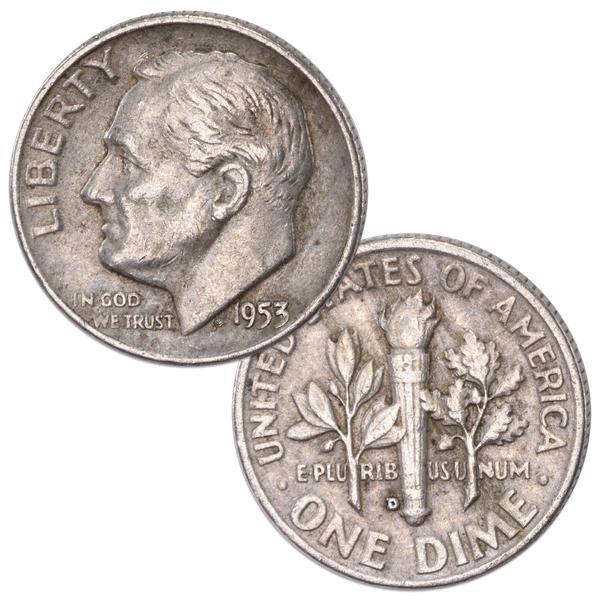
Most Roosevelt dimes look nearly identical, but one quick check of the date can reveal a coin containing real silver.
Today’s Check Your Change find is the 1946–1964 Roosevelt silver dime. These coins have largely disappeared from circulation, yet an occasional example can still surface in pocket change, bank rolls, coin jars, cash registers and inherited collections.
What should you look for?
Examine the date beneath Franklin D. Roosevelt’s portrait. Any standard U.S. Roosevelt dime dated 1946 through 1964 was struck in an alloy of 90% silver and 10% copper.
You can also inspect the reeded edge:
- A silver dime generally has a solid silver-gray edge.
- A modern clad dime normally shows a noticeable copper-colored stripe along its edge.
The date is the most dependable basic test. Do not mistake ordinary discoloration, plating or environmental damage on a newer dime for silver.
Older Mercury dimes and Barber dimes are also 90% silver, but their designs are noticeably different from the familiar Roosevelt dime.
A little history
The Roosevelt dime entered circulation in 1946, shortly after President Franklin D. Roosevelt’s death. The denomination was especially appropriate because Roosevelt had supported the March of Dimes and its campaign against polio.
Chief Engraver John R. Sinnock designed the coin. Its reverse features a torch representing liberty, an olive branch representing peace and an oak branch representing strength and independence.
Silver prices and widespread coin shortages eventually led Congress to pass the Coinage Act of 1965. Beginning in 1965, circulating dimes were made from copper-nickel clad material instead of silver. The familiar Roosevelt design remained, making the date especially important.
How much is a silver Roosevelt dime worth?
Each 1946–1964 Roosevelt dime originally contained approximately 0.0723 troy ounce of silver.
Based on silver prices on September 15, 2026, NGC and Coinflation calculated a silver value of approximately $4.57 to $4.67 per dime. Silver prices change throughout the day, so this figure will rise or fall with the market. A dealer’s actual buying price may also differ from the calculated melt value.
Most worn, common-date silver Roosevelt dimes trade primarily for their silver content. Coins with scarce varieties, attractive original surfaces or unusually high grades may carry an additional collector premium. Authentication and condition determine the actual value.
What should you do if you find one?
Do not clean, polish, scrub or dip the dime. Cleaning can permanently alter its surface and reduce any collector premium.
Hold it by the edges, photograph both sides and place it in a non-PVC coin flip or protective capsule. Record the date and mintmark. On silver Roosevelt dimes, a D or S mintmark—when present—is found on the reverse near the lower-left side of the torch.
Have you found an old silver dime—or do you have coins, paper currency or an inherited collection? The Patriot Vault may be interested in buying your coin, currency or broader collection. Reply to this post and tell us what you have!