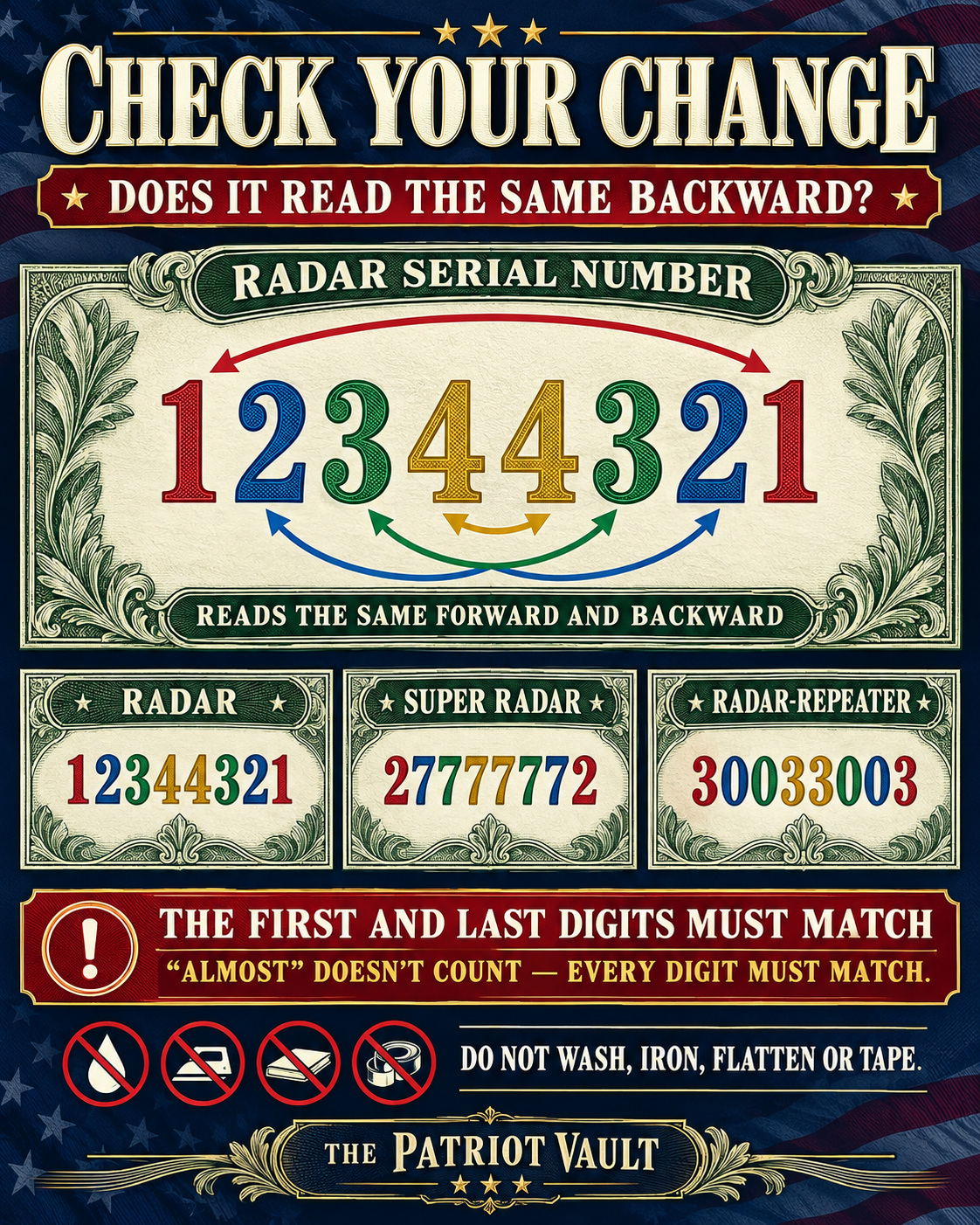
Before spending your next dollar bill, check its serial number. If the eight digits read exactly the same forward and backward, you have found a collectible radar note.
Radar serial numbers can appear on modern $1, $2, $5, $10, $20, $50 and $100 bills, making this a variety anyone can realistically discover in a wallet, cash register or bank withdrawal.
What should you look for?
Ignore the letters at the beginning and end for the basic test. Concentrate on the eight numerical digits.
A true radar serial number is a palindrome: the first digit matches the eighth, the second matches the seventh, the third matches the sixth and the fourth matches the fifth.
Examples include:
- 12344321
- 30000003
- 07633670
- 67777776
Read any of these numbers backward and the sequence remains unchanged. PMG and PCGS both recognize radar serial numbers as an established category of collectible “fancy” serial numbers.
A number that misses the pattern by one digit—sometimes advertised as an “almost radar”—is not a true radar and generally does not command the same collector interest.
Why are they called radar notes?
“Radar” itself reads the same forward and backward, so currency collectors adopted the term for serial numbers sharing that characteristic.
Some radar notes qualify for additional categories:
- Radar-repeater: The number reads identically backward and also repeats a pattern, such as 30033003.
- Binary radar: The number uses only two different digits while also reading identically backward.
- Super radar: All six middle digits are identical, such as 27777772.
- Star-note radar: A genuine radar serial appearing on a replacement star note.
These combinations are generally scarcer and may attract stronger collector demand than an ordinary radar.
How much is a radar note worth?
Value depends on the denomination, condition, age, visual appeal and strength of the pattern.
As of October 2026, an ordinary modern radar note with noticeable circulation wear may sell for approximately $10 to $40 over face value. Crisp examples with attractive patterns may bring approximately $40 to $100 or more.
Stronger combinations can sell for substantially more. Recent auction records include radar or radar-repeater $1 notes selling for approximately $140 to $192, while particularly attractive patterns, older note types, star notes and high-grade certified examples have brought hundreds of dollars.
Those results are examples, not guaranteed prices. A heavily worn, stained or damaged bill may receive little interest, while a crisp note with a visually striking pattern may command a larger premium.
What should you do if you find one?
Do not wash, iron, press, flatten, tape or laminate the bill. Leave folds and natural paper characteristics alone.
Handle it with clean, dry hands, photograph both sides and take a clear close-up of the complete serial number. Store it flat inside an archival-quality, PVC-free currency sleeve. Check both serial numbers on the front to ensure they match; mismatched numbers could indicate a different type of printing error requiring authentication.
Have you found a radar note—or do you have old currency, coins or a broader collection? The Patriot Vault may be interested in buying your coin, currency or collection. Reply to this post and tell us what you have!