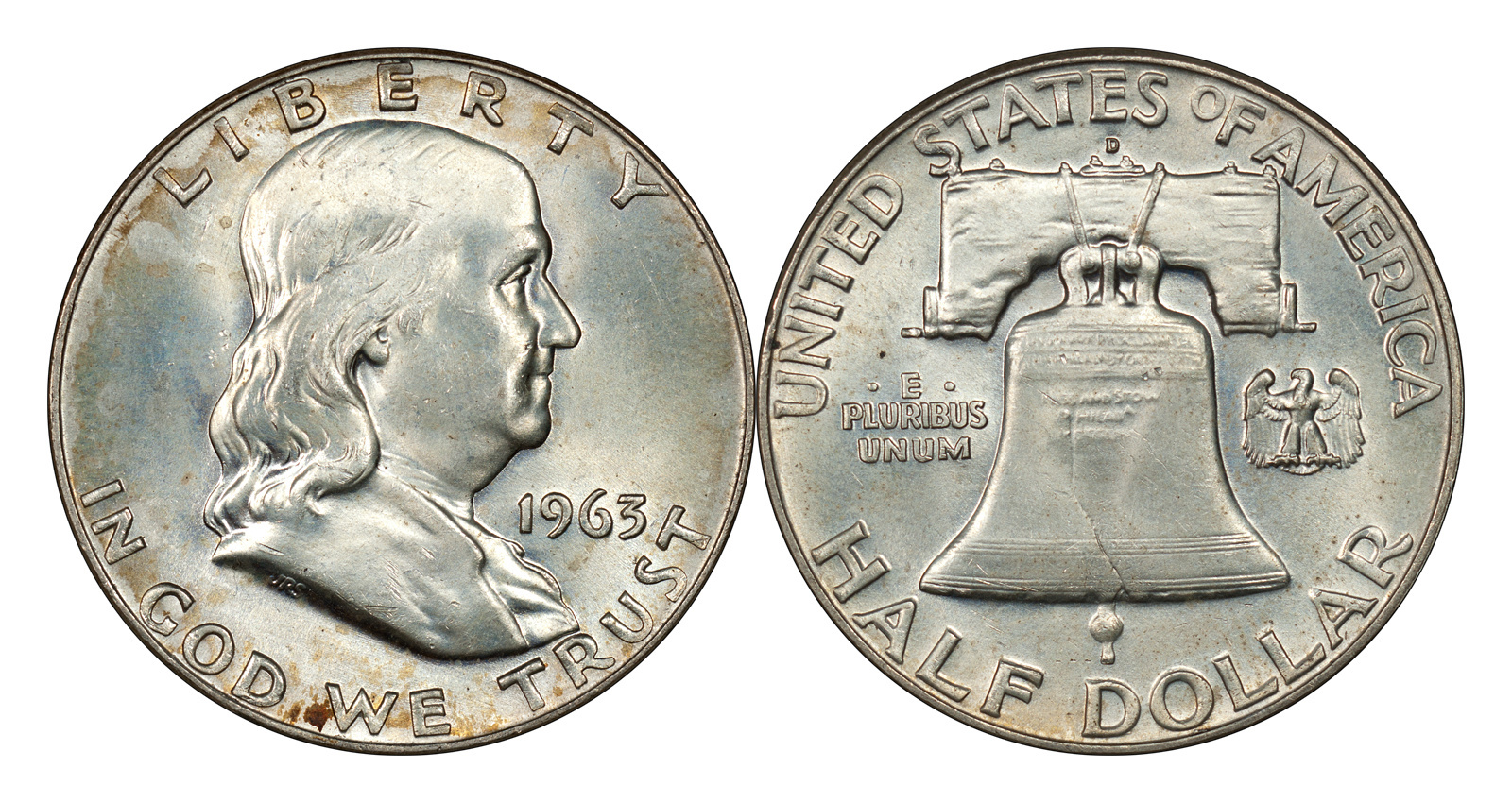
A half dollar featuring Benjamin Franklin is worth setting aside. Every regular-issue Franklin half dollar was struck from 90% silver and is worth considerably more than its 50-cent face value—even when worn.
What should you look for?
Franklin half dollars were produced from 1948 through 1963.
The front features Benjamin Franklin facing right, with the date below his portrait. The back displays the Liberty Bell, accompanied by a small eagle to the right.
You can confirm one by checking for:
- A date from 1948 through 1963
- Benjamin Franklin’s portrait on the front
- The Liberty Bell on the back
- A generally solid silver-gray edge without the copper-colored stripe seen on modern clad coins
A D or S mintmark, when present, appears above the Liberty Bell. No mintmark generally indicates production at the Philadelphia Mint.
A little history
U.S. Mint Director Nellie Tayloe Ross had long admired Benjamin Franklin and supported placing him on a circulating coin. The Franklin half dollar entered circulation on April 30, 1948, replacing the Walking Liberty design.
Chief Engraver John R. Sinnock created Franklin’s portrait and adapted the Liberty Bell for the reverse. A small eagle was added because federal law required an eagle to appear on the half dollar.
The series ended after only 16 years. Following President John F. Kennedy’s assassination, Congress authorized a new Kennedy half dollar, which entered circulation in 1964.
How much is a Franklin half dollar worth?
Every Franklin half dollar contains approximately 0.36169 troy ounce of pure silver. On September 29, 2026, NGC’s live calculator placed its silver value at approximately $22.03. Silver prices change throughout the day, and a dealer’s buying price may differ from the calculated melt value.
Common circulated examples generally trade around $22 to $28, depending on the current silver price, wear and market demand. Better dates, attractive original surfaces and uncirculated coins may bring additional collector premiums.
Collectors pay particular attention to the horizontal lines across the lower portion of the Liberty Bell. On sharply struck, unworn coins, grading services may award a Full Bell Lines designation. This feature can increase the value substantially for certain dates, but it normally applies only to well-preserved examples—not heavily circulated coins.
Authentication and condition determine the actual value. Scratches, rim damage, cleaning, staining and heavy wear can reduce a coin’s collector premium, although its silver content remains valuable.
What should you do if you find one?
Do not clean, polish, scrub or dip the coin. Cleaning can permanently alter the surface and reduce its collector value.
Hold it by the edges, photograph both sides and record the date and mintmark. Place it in a non-PVC coin flip or protective capsule, away from loose coins.
Have you found a Franklin half dollar—or do you have coins, paper currency or a larger inherited collection? The Patriot Vault may be interested in buying your coin, currency or broader collection. Reply to this post and tell us what you have!