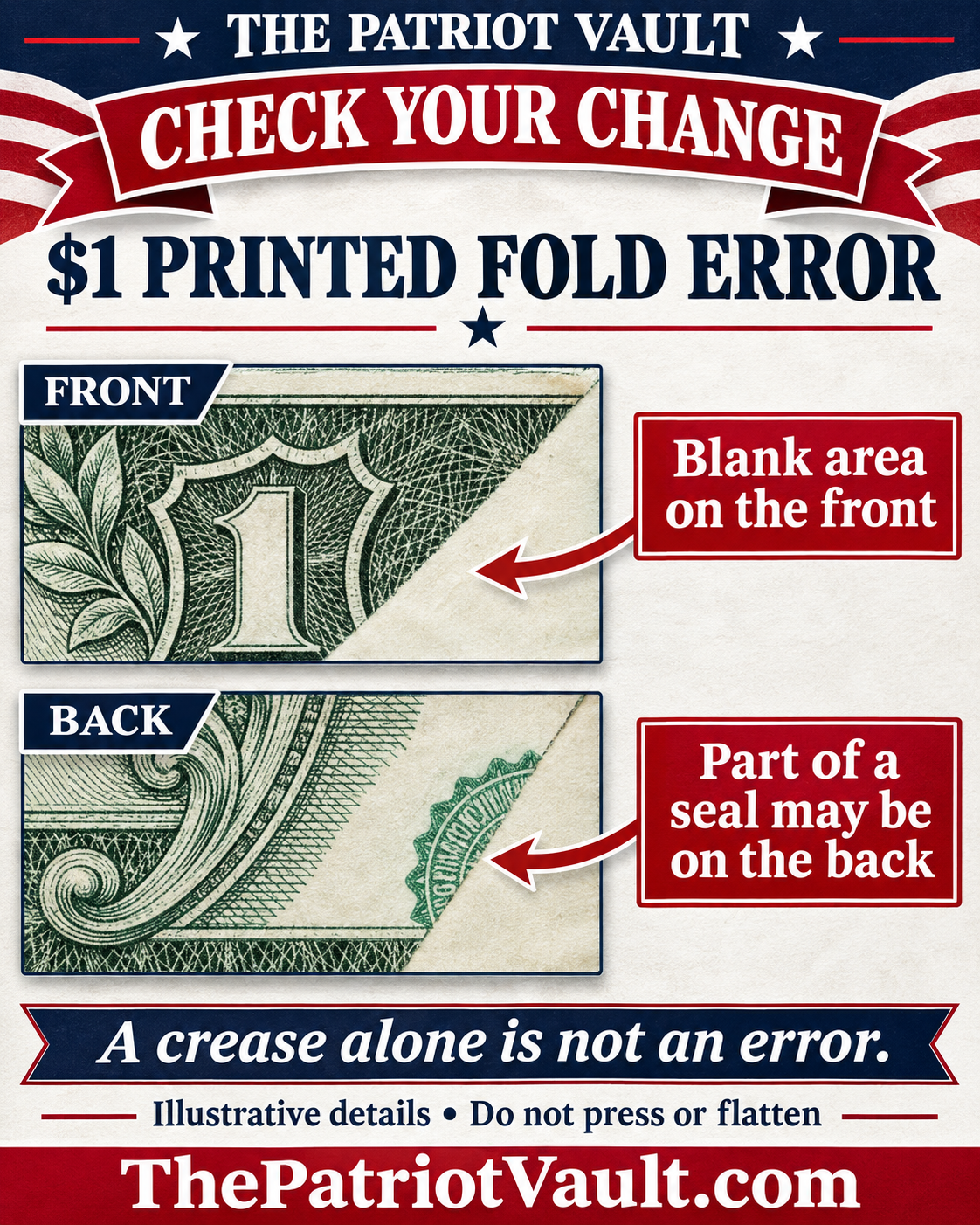
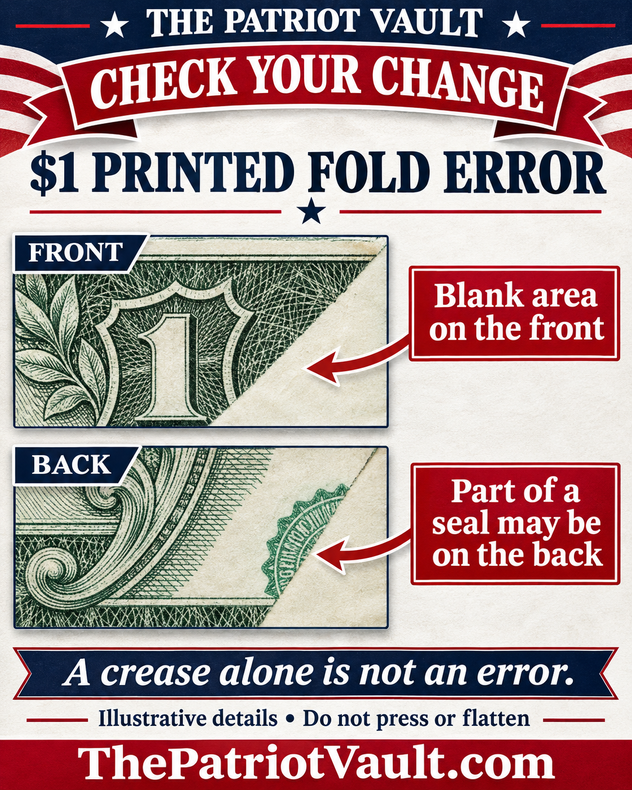
A crease in a dollar bill usually means it spent time in someone’s wallet. But if the printing stops at that crease—or part of a green Treasury seal appears where it shouldn’t on the back—you may have a $1 printed fold error. It’s an uncommon circulation find, but checking takes only a few seconds and doesn’t require special equipment.
What to look for on both sides
Start on the front. Look for a sharp diagonal interruption near a corner: part of the border, lettering, or other printed detail may stop abruptly, leaving a patch of unprinted paper. Then turn the bill over without pulling at the corner. On some examples, you’ll see a fragment of the Treasury seal, a district number, or part of a serial number on the back—features normally printed on the front. Not every printed fold shows both clues.
The important distinction is what happened to the printing, not how deep the crease looks. Folding an ordinary dollar after it leaves the printer doesn’t move a seal to the back. A stain, abrasion, or patch of missing ink on its own isn’t enough to identify the error, either. Compare both sides with an ordinary dollar and look for a break or displaced ink that follows the fold. An unusual corner is a reason to look closer, not proof of a printing error.
How a printed fold happens
U.S. notes are printed in sheets. For a $1 Federal Reserve Note, the back is printed first, then the main design on the face, then the overprint that includes the serial numbers and seals. If part of the sheet folds between passes, the next pass can print on the exposed flap instead of the intended surface. This is why one note may have a gap in the face design, while another has a misplaced seal or serial-number fragment. PMG’s printed-fold guide shows how the timing of the fold affects the result.
What is a $1 printed fold error worth?
As of November 27, 2026, the Heritage Auctions archive provides a useful comparison: three certified $1 printed folds sold for $324 to $900 on August 31, 2025. Two sold for $324 and $360 in uncirculated grades; the $900 note was graded About Uncirculated 53 but showed a blank area on the face and both the Treasury seal and right serial number on the back. That’s a good reminder that how clearly the error shows can matter as much as the grade. These are comparable sales, not a price range for every circulated find. Authentication, condition, and the extent of the error determine value.
What to do if you find one
Keep it as found. Don’t clean, polish, press, iron, flatten, tape, or otherwise alter it. Don’t force a folded corner open. Photograph both sides and take a close-up of the affected area. Use an archival currency sleeve if the note fits without pressure; otherwise, protect it in a rigid holder with room for the fold. A paper-money specialist can help confirm whether the fold happened during printing.
Found a possible printed fold—or have other coins, paper money, or a larger collection? The Patriot Vault may be interested in buying. Reply to this post and tell us what you have!