A bill does not need a printing mistake or an old series date to interest collectors. Sometimes the value is hiding in the eight digits of its serial number.
Today’s Check Your Change find is the ladder serial number—a sequence that climbs upward or counts downward in perfect numerical order.
What should you look for?
Check the two green serial numbers printed on the front of every bill. Each Federal Reserve note carries a unique serial number that appears twice.
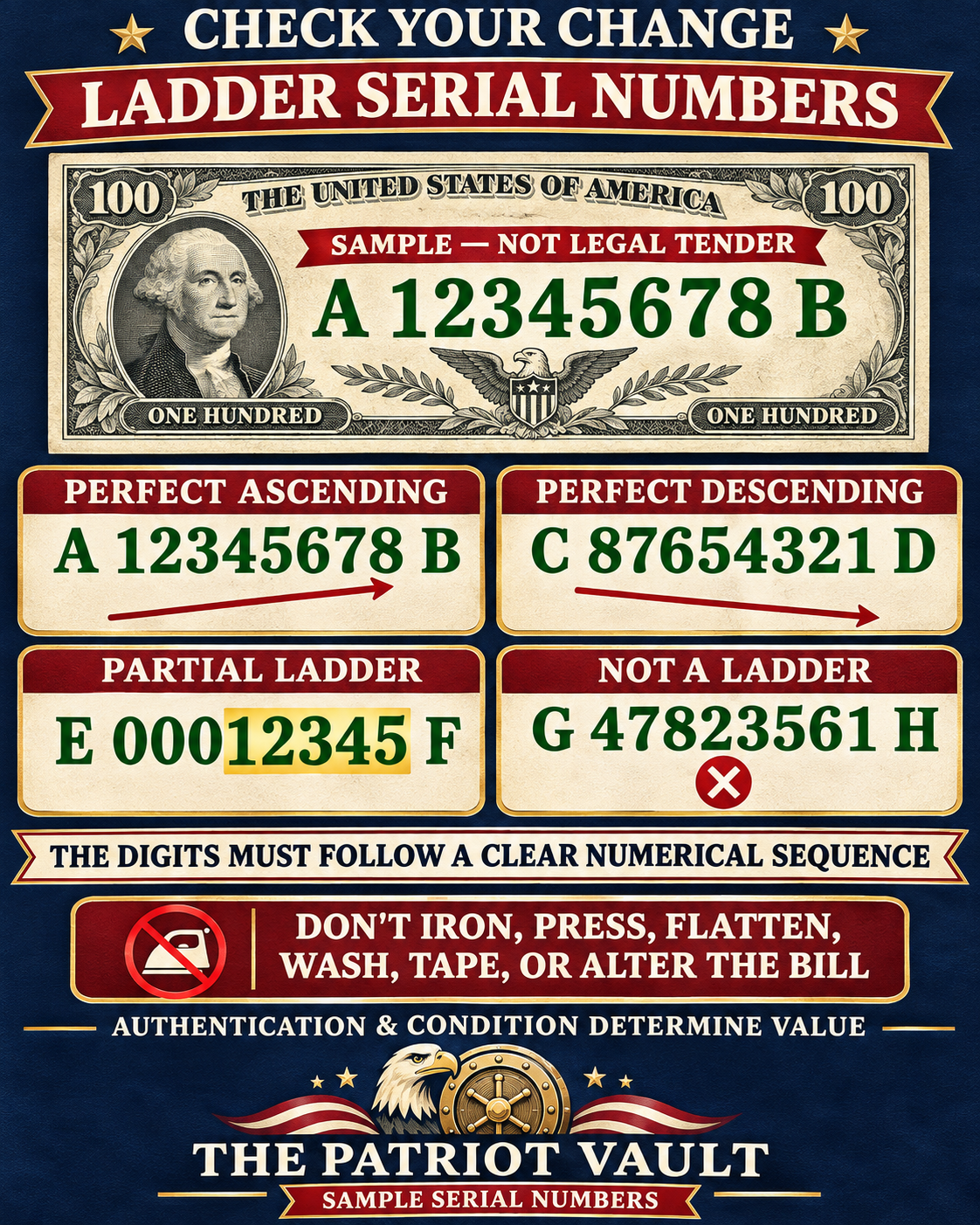
The most desirable “perfect ladders” include:
- 12345678 — ascending ladder
- 87654321 — descending ladder
- 01234567 — ascending ladder beginning with zero
- 98765432 — descending ladder beginning with nine
PMG recognizes ascending and descending ladders as collectible fancy serial numbers. Zero may serve as either the lowest or highest digit in an accepted sequence.
Partial ladders can also attract interest. Examples include 00012345, 08765432 or another sequence containing several consecutive ascending or descending digits.
Do not confuse a true ladder with a serial number that merely contains all eight digits in random order. A number such as 47823561 is a mixed sequence, not a ladder, and ordinarily carries no special premium. Stack’s Bowers notes that collectors pursue perfect and partial ladders, while randomly mixed “ladders” generally do not qualify.
Why are ladder numbers collectible?
Serial numbers are assigned during the currency overprinting process. The Bureau of Engraving and Printing applies two serial numbers, Treasury and Federal Reserve seals, and other identifiers before sheets are cut into individual notes.
A ladder is not a printing error. Its appeal comes from the rarity and visual order of the number itself. Because serial numbers advance through enormous production runs, perfect sequences can appear on otherwise ordinary bills and may enter circulation through banks, ATMs and cash drawers.
How much is a ladder serial-number bill worth?
Value depends on the exact sequence, denomination, series, condition and collector demand.
As a realistic November 2026 guide:
- Short or partial ladders may bring approximately $25–$200
- Longer, attractive partial ladders may bring $100–$500 or more
- Perfect eight-digit ladders frequently bring $1,000–$4,000, especially in certified uncirculated condition
Recent auction results illustrate the difference. A certified $1 note with partial descending number 08765432 sold for $169 in December 2025. A Gem Uncirculated $1 note numbered 87654321 brought $2,280 in May 2024, while a $5 note numbered 12345678 realized $2,520 in 2022.
A Gem Uncirculated $2 note numbered 98765432 sold for $3,600 in September 2024, but that particular denomination and issue was especially scarce.
These are completed-auction comparisons—not guaranteed values. Folds, stains, writing, tears, poor centering and repairs can reduce a note’s desirability substantially. Authentication and condition determine what an individual bill is actually worth.
What should you do if you find one?
Do not wash, iron, press, flatten, laminate, erase or tape the bill. Handle it with clean, dry hands and place it flat in an archival-quality, PVC-free currency sleeve.
Photograph the front and back, record the complete serial number and consider professional grading for a perfect ladder or an exceptionally well-preserved note.
Have you found a ladder serial number—or do you have coins, paper currency or a broader collection? The Patriot Vault may be interested in buying your bill, coin, currency or collection. Reply to this post and tell us what you have!