An older two-dollar bill with a bright red seal may be worth more than its printed value—and it can still surface in cash drawers, old wallets and inherited collections.
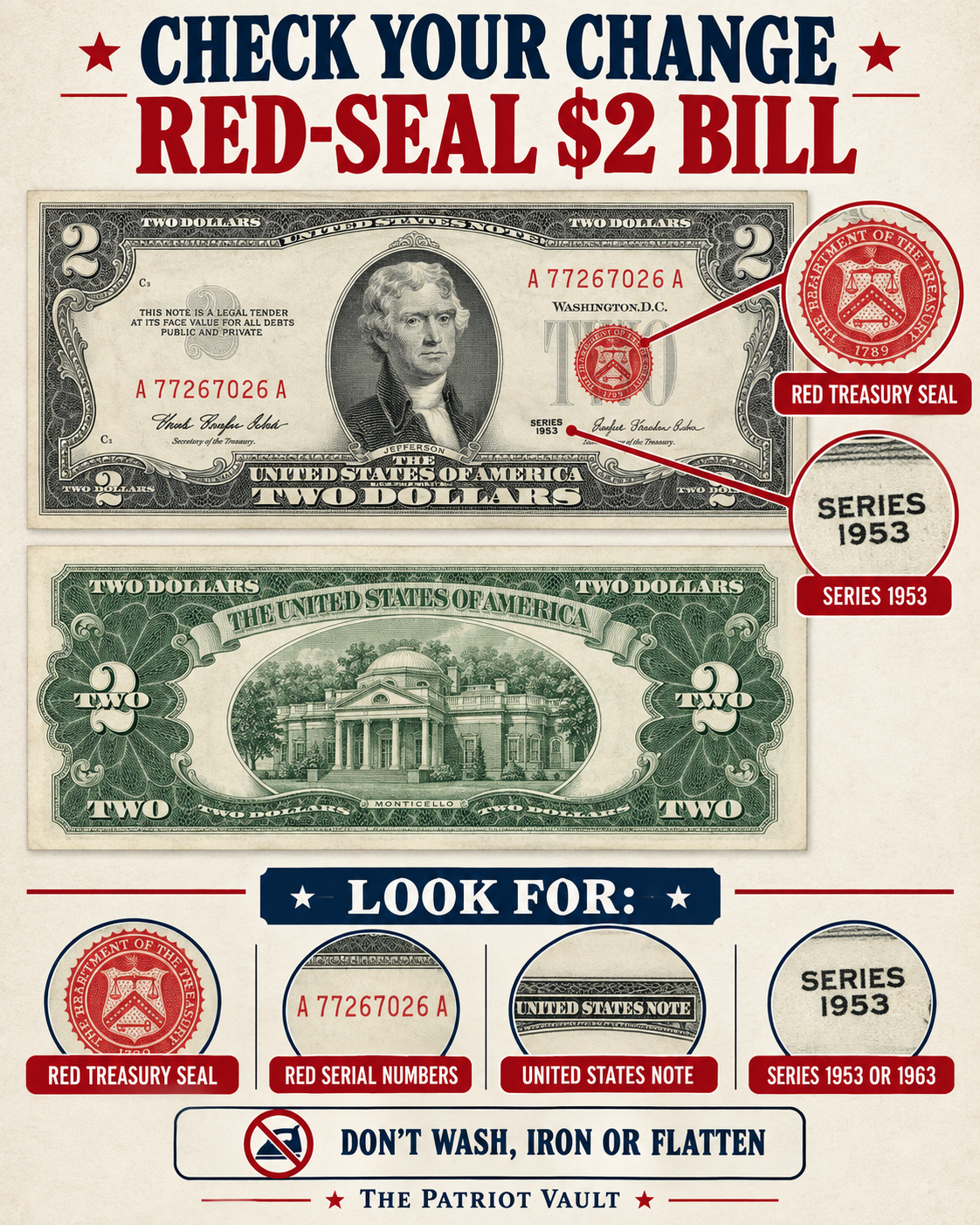
Today’s Check Your Change find is the Series 1953 or 1963 $2 United States Note, commonly called a red-seal two-dollar bill.
What should you look for?
Start with the front of the bill. A genuine red-seal $2 United States Note features Thomas Jefferson and should have:
- A red Treasury seal to the right of Jefferson
- Red serial numbers
- The words “UNITED STATES NOTE” across the top
- A series designation of 1953, 1953A, 1953B, 1953C, 1963 or 1963A
The back depicts Jefferson’s home, Monticello. This distinguishes it from modern green-seal $2 Federal Reserve Notes, whose reverse shows the signing of the Declaration of Independence.
Also inspect the serial number for a star symbol. Star notes were printed to replace notes damaged during production and may receive an additional collector premium, depending on their scarcity and condition.
A little history
Small-size $2 United States Notes were introduced in 1928. The Series 1953 and 1963 issues retained Jefferson’s portrait and the Monticello reverse but moved the red Treasury seal to the right side of the portrait.
The Series 1963 note was the first $2 bill to carry “IN GOD WE TRUST” on the reverse. It also eliminated the older promise that the government would “pay to the bearer on demand.” The familiar red-seal United States Note was eventually replaced by the redesigned green-seal Federal Reserve $2 note issued for the nation’s Bicentennial in 1976.
How much is a red-seal $2 bill worth?
Most Series 1953 and 1963 red-seal notes are collectible but not extremely rare.
Typical circulated examples with folds and moderate wear generally sell for approximately $3 to $8. Cleaner, lightly circulated notes may bring about $6 to $12, while crisp uncirculated examples commonly sell for roughly $12 to $25.
Star notes, unusual serial numbers, genuine printing errors and exceptionally well-preserved notes can be worth more. However, tears, stains, writing, tape repairs, missing corners and heavy creases may reduce a note’s value substantially.
These amounts are general retail estimates, not guaranteed offers. The exact series, serial number, originality, condition and authentication determine what an individual note is worth. Current collector guides list Series 1953 and 1963 notes separately because the particular issue and condition can affect market value.
What should you do if you find one?
Do not wash, iron, press, flatten, laminate or tape the note. Attempts to remove folds can damage its paper fibers and reduce collector value.
Handle it with clean, dry hands, photograph the front and back and record the complete serial number. Store it flat in an archival-quality, PVC-free currency sleeve.
Have you found a red-seal $2 bill—or do you have old coins, paper currency or an inherited collection? The Patriot Vault may be interested in buying your coin, currency or broader collection. Reply to this post and tell us what you have!