A 1964-D Roosevelt dime is already worth more than ten cents because of its silver content—but one recognized doubled-die variety may carry a considerably larger collector premium.
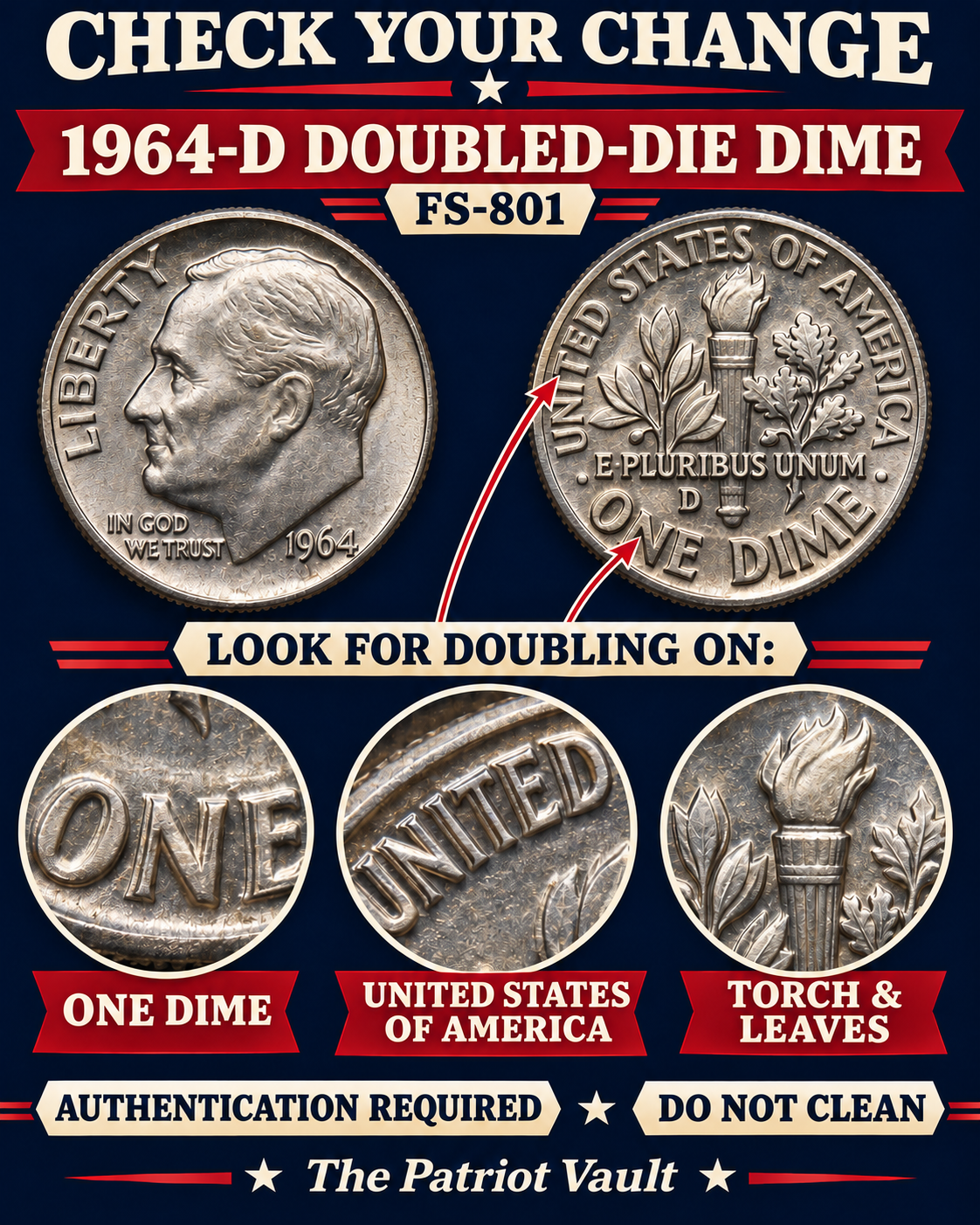
Today’s Check Your Change find is the 1964-D Doubled Die Reverse Roosevelt dime, cataloged as FS-801, CONECA DDR-001 and NGC VarietyPlus VP-001.
What should you look for?
Begin with a Roosevelt dime dated 1964. Turn it over and confirm that a small D mintmark appears to the left of the torch’s base.
Next, examine the reverse under magnification. The FS-801 variety displays strong doubling across much of the design, especially:
- ONE DIME
- UNITED STATES OF AMERICA
- Portions of the torch
- The olive and oak leaves
The doubled details resemble a second image rotated slightly counterclockwise. PCGS notes that virtually every reverse letter and some design elements display doubling. GreatCollections describes particularly visible doubling on ONE DIME, UNITED STATES OF AMERICA and the leaves.
Don’t rely on one blurry or damaged letter. Genuine FS-801 doubling follows a consistent pattern across numerous parts of the reverse. Flat, shelf-like machine doubling, ordinary wear and coin damage are not the same variety. Several different 1964-D doubled reverses also exist, so comparison with an authenticated FS-801 example is important.
How did the doubling happen?
A doubled die forms while a coin die is being manufactured. Misalignment between hub impressions creates a doubled design on the die itself. Every coin struck by that die then receives the same repeated details.
This differs from a coin being struck twice or damaged after leaving the Mint.
The Roosevelt dime debuted in 1946 to honor Franklin D. Roosevelt, whose support of the March of Dimes made the denomination especially appropriate. The reverse torch, olive branch and oak branch symbolize liberty, peace and strength. The Mint removed silver from regular dimes beginning in 1965, making 1964 the final date of the traditional 90% silver circulating issue.
How much is a 1964-D FS-801 dime worth?
As of November 20, 2026, worn authenticated examples may trade for approximately $20 to $50, depending on how clearly the doubling remains visible.
Uncirculated examples can bring roughly $75 to $300 or more, with grade, surface preservation and strike quality making a substantial difference. Heritage auction results reported by Greysheet include certified MS64 examples that sold for $207 and $220 in 2026. GreatCollections records sales ranging from $36 to $119 for certified examples graded AU50 through MS63.
These results are reference points, not guaranteed offers. Cleaning, scratches, dark spots, rim damage and heavy wear may lower the value. Authentication is especially important because other doubled-die varieties and forms of mechanical doubling can appear similar.
What should you do if you find one?
Do not clean, polish, rub, dip or otherwise alter the dime. Hold it by the edges and photograph both sides. Take sharp close-ups of ONE DIME, UNITED STATES OF AMERICA, the leaves and torch.
Place it in a non-PVC coin flip or protective capsule. A promising example should be compared with the and before professional authentication is considered.
Have you found a doubled 1964-D dime—or do you have coins, currency or a broader collection? The Patriot Vault may be interested in buying it. Reply to this post and tell us what you have!