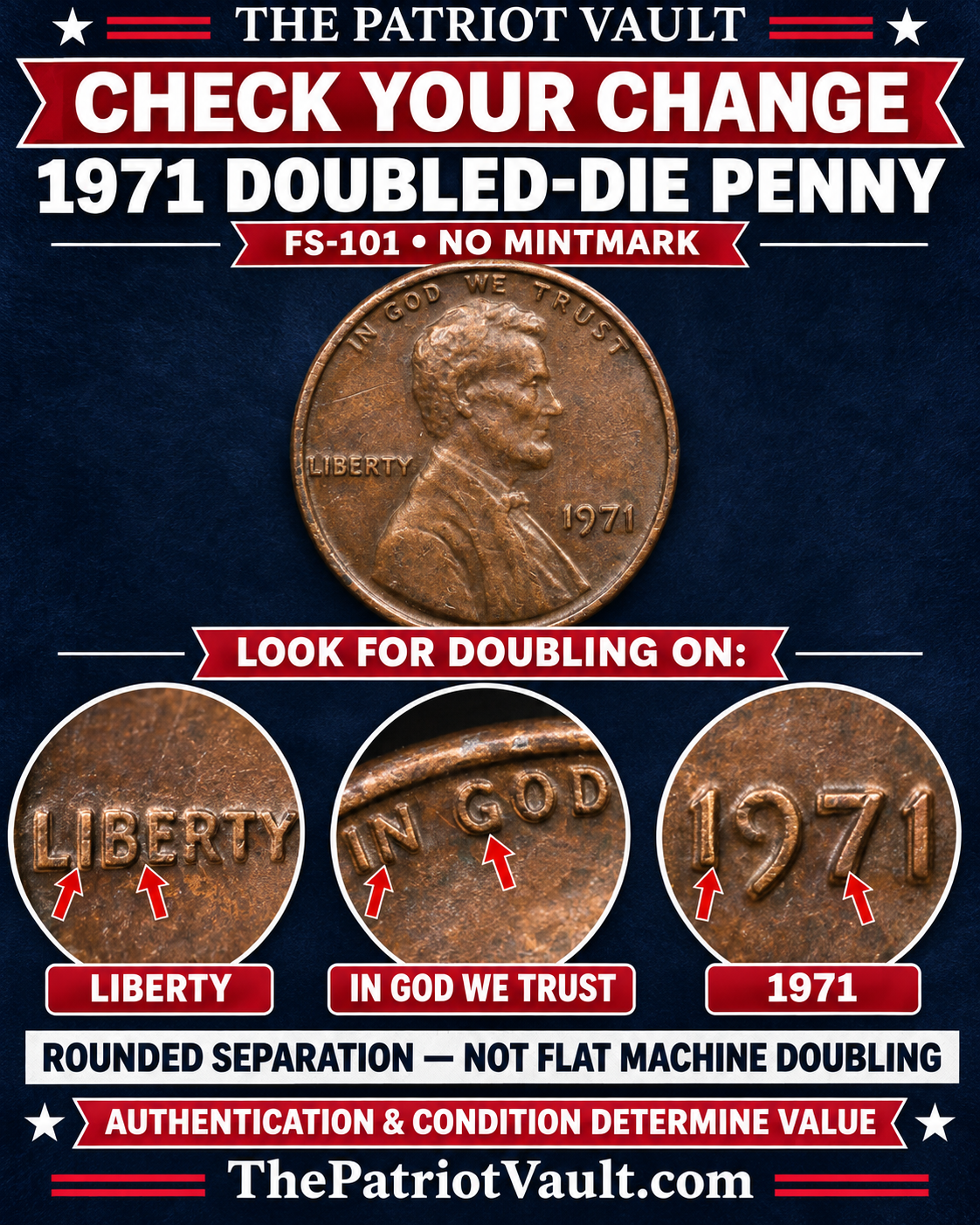
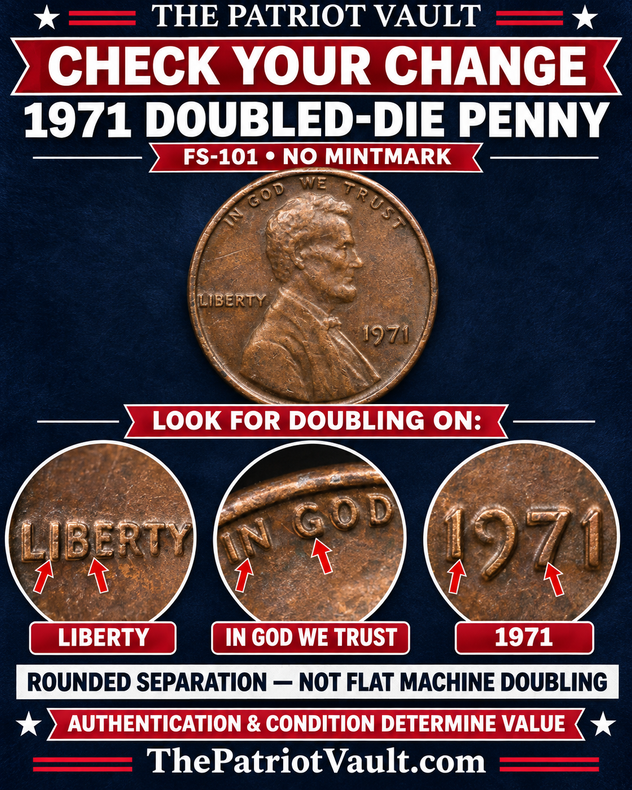
A 1971 Lincoln penny without a mintmark may be worth considerably more than one cent if its lettering displays the right kind of doubling.
Today’s Check Your Change find is the 1971 Doubled Die Obverse Lincoln cent, commonly identified as FS-101.
What should you look for?
Start with a Lincoln Memorial penny dated 1971. The major FS-101 variety was struck at the Philadelphia Mint, so there should be no mintmark beneath the date.
Using a magnifying glass or sharply focused phone photograph, examine three areas on the front:
- LIBERTY
- IN GOD WE TRUST
- The date 1971
The doubling is normally strongest on LIBERTY and IN GOD WE TRUST. Look for rounded secondary images, visible separation and small notches where portions of the letters overlap.
The date can also display doubling, although it may be less noticeable than the lettering. PCGS notes that magnification is usually needed to identify this variety.
Do not confuse a genuine doubled die with ordinary machine doubling. Machine doubling usually appears flat, shelf-like or scraped, without rounded secondary lettering. Circulation damage and shadows in photographs can also resemble doubling.
How did the doubling happen?
A doubled die is created while a working die is being manufactured. If the design impressions are slightly misaligned, doubled features become part of the die itself. Every coin struck by that die receives the same diagnostic details.
This is different from a coin being struck twice or damaged after leaving the Mint.
Philadelphia produced approximately 1.92 billion Lincoln cents in 1971, but only a small number were struck from the major doubled die. PCGS describes the variety as scarce, with only a few hundred examples known and substantially fewer surviving in Mint State.
How much is a 1971 doubled-die penny worth?
Authentication, wear, original color and surface preservation determine value.
Authenticated circulated examples may be worth approximately $75 to $250, depending on how much detail remains and whether the coin has scratches, corrosion or other problems.
PCGS currently lists typical Mint State Brown examples at approximately $150 to $600, depending on grade. Red-Brown and original Red coins may be worth more.
A certified MS63 Red example sold for $1,830 in March 2026, while exceptional higher-grade specimens have produced much larger auction results. Those figures should not be treated as expected values for circulated pennies found in change.
What should you do if you find one?
Do not clean, polish, rub, scrape or otherwise alter the penny. Cleaning removes original surface material and can substantially reduce collector value.
Hold it by its edges and photograph both sides. Take close-ups of LIBERTY, IN GOD WE TRUST and the date. Place the coin in a non-PVC holder and compare it with professionally authenticated FS-101 examples before selling it.
Have you found a possible 1971 doubled die—or do you have coins, paper currency or a larger collection? The Patriot Vault may be interested in buying your coin, currency or broader collection. Reply to this post and tell us what you have!