Most Series 1976 two-dollar bills are worth only face value, but one small symbol beside the serial number can make a note more collectible.
Today’s Check Your Change find is the Series 1976 $2 Federal Reserve star note.
What should you look for?
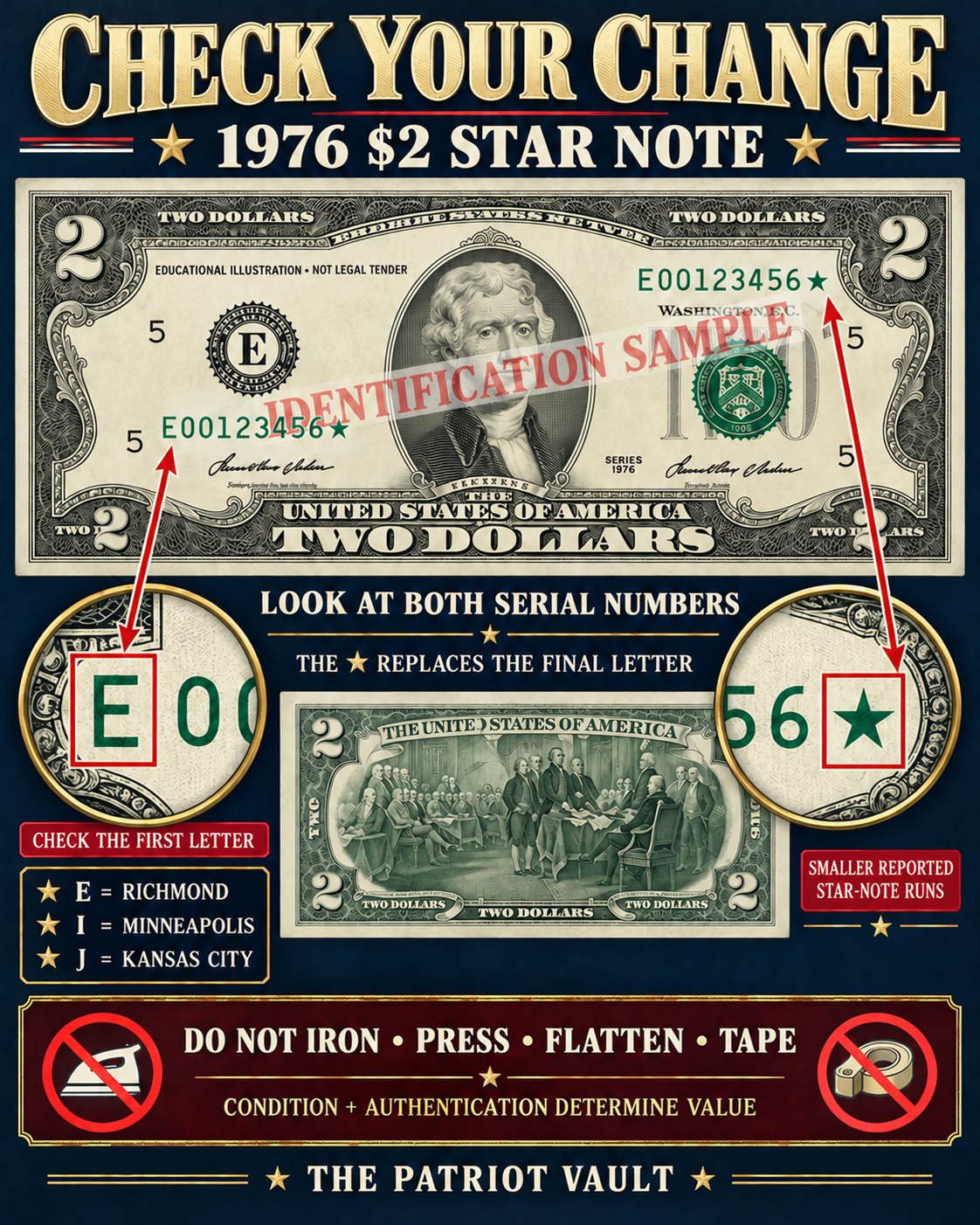
Begin by checking the series year printed near the lower-right corner of Thomas Jefferson’s portrait. It must read Series 1976.
Next, examine both green serial numbers. A regular note ends with a letter. A replacement note has a small star at the end of each serial number.
For example:
- Regular note: E12345678A
- Star note: E00123456★
The star must be printed as part of both serial numbers. A handwritten star, ink spot or other mark does not count.
The first letter identifies the issuing Federal Reserve Bank. Series 1976 stars beginning with E for Richmond, I for Minneapolis or J for Kansas City came from smaller reported production runs of approximately 640,000 notes each. However, print quantity alone does not guarantee a large premium; condition and collector demand still matter.
Why is there a star?
When the Bureau of Engraving and Printing discovers an imperfect sheet after serial numbers have been applied, it does not reproduce every original number. Instead, a separately numbered replacement sheet is inserted. A star replaces the final serial-number letter to identify these replacement notes.
Series 1976 marked the first $2 Federal Reserve Note. Issued for America’s Bicentennial, it retained Thomas Jefferson’s portrait but replaced Monticello on the back with an engraving based on John Trumbull’s painting of the signing of the Declaration of Independence. The notes entered circulation on April 13, 1976.
How much is a 1976 $2 star note worth?
An ordinary worn 1976 two-dollar bill without a star is generally worth $2. Even uncirculated regular notes are common because many people saved them when issued.
As of October 2026:
- Worn star notes from more common districts may bring approximately $3 to $10
- Crisp or attractive common-district stars may sell for roughly $10 to $40
- Attractive Richmond, Minneapolis or Kansas City stars may bring approximately $40 to $125 or more, depending on grade and serial number
In May 2026, two professionally graded Kansas City star notes—PMG 66 and PMG 67—sold together for $244. Greysheet listings show higher-grade star-note values varying considerably by Federal Reserve district.
Low serial numbers, fancy patterns, printing errors and exceptional certified grades can add value, but those features require separate authentication. Online asking prices should not be treated as completed-sale values.
What should you do if you find one?
Do not wash, iron, press, flatten, laminate, tape or otherwise alter the bill. Original paper and embossing are important to currency collectors.
Photograph the entire front and back, including both serial numbers. Handle the note carefully with clean, dry hands and store it flat in an archival-quality, PVC-free currency sleeve.
Have you found a 1976 star note—or do you have coins, paper currency or a broader collection? The Patriot Vault may be interested in buying it. Reply to this post and tell us what you have!