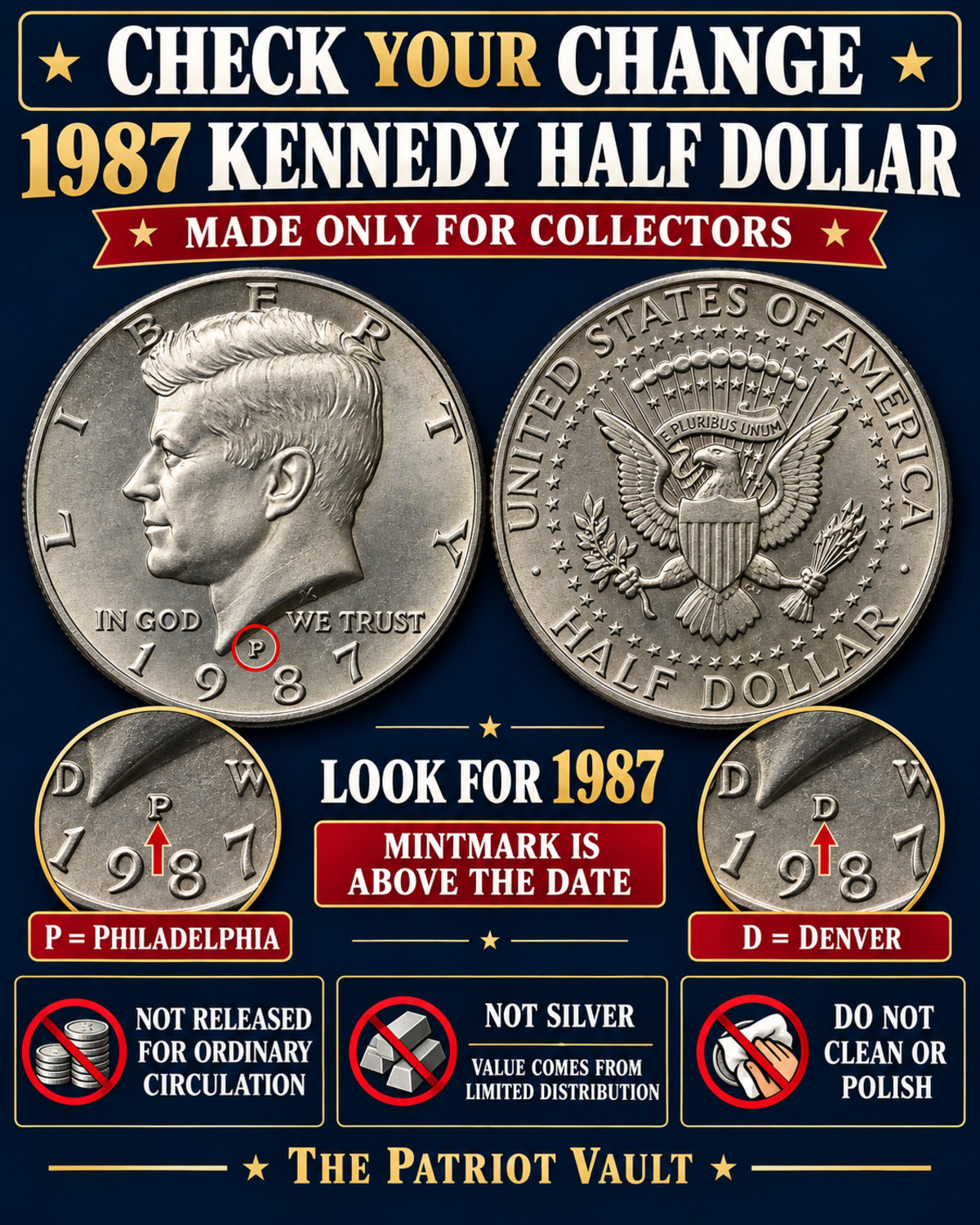
A Kennedy half dollar dated 1987 is worth setting aside. Unlike ordinary half dollars produced during surrounding years, the 1987-P and 1987-D Kennedy halves were not released through the Federal Reserve for everyday circulation.
They were originally available only in United States Mint Sets—but some have escaped into bank rolls and cash drawers over the years.
What should you look for?
Examine the date beneath President John F. Kennedy’s portrait. The coin must be dated 1987.
Immediately above the date, look for one of two mintmarks:
- P: Philadelphia Mint
- D: Denver Mint
Both versions are collectible. The reverse features the familiar presidential-seal design with a heraldic eagle holding an olive branch and arrows.
These coins do not contain silver. They have the same copper-nickel-clad composition as other standard Kennedy half dollars made since 1971. Their premium comes from their limited collector-only distribution—not their metal content.
Why is the 1987 half dollar different?
By the 1980s, half dollars had largely disappeared from daily commerce. Many people saved them, businesses rarely used them and few vending machines accepted them.
Because the country already had an adequate supply, the Mint did not produce Kennedy halves for general circulation in 1987. Instead, Philadelphia and Denver business strikes were included only in the year’s Uncirculated Mint Sets.
Approximately 2,890,758 of each mintmark were produced. That is a low total compared with many surrounding Kennedy half-dollar issues.
PCGS explains that the 1987-P and 1987-D remain among the scarcest business-strike Kennedy halves produced before the Mint ended routine circulation releases after 2001.
When people break apart old Mint Sets, the individual coins may be spent, deposited at banks or mixed into inherited accumulations. That makes the 1987 half a legitimate bank-roll and coin-jar find.
How much is a 1987 Kennedy half dollar worth?
Value depends heavily on condition.
A worn example that has circulated may bring approximately $1 to $3, although damaged coins can be worth less. Attractive uncirculated examples commonly sell for approximately $4 to $10.
PCGS reports that certified 1987-P and 1987-D halves commonly encountered in MS65 to MS66 condition have historically brought around $7 to $10. Exceptional certified coins can be worth substantially more, but those prices should not be applied to ordinary raw examples.
Look for original mint luster, clean fields, strong details and minimal contact marks. Scratches, staining, rim damage and cleaning will reduce collector interest.
Authentication and condition determine the actual value. Online asking prices do not necessarily represent completed sales.
What should you do if you find one?
Do not clean, polish, dip or rub the coin. Even a soft cloth can leave fine scratches on its original surface.
Hold it by the edges, photograph both sides and take a close-up of the mintmark and date. Store it in a non-PVC coin flip or protective capsule.
Have you found a 1987 Kennedy half—or do you have coins, paper currency or a larger inherited collection? The Patriot Vault may be interested in buying your coin, currency or broader collection. Reply to this post and tell us what you have!