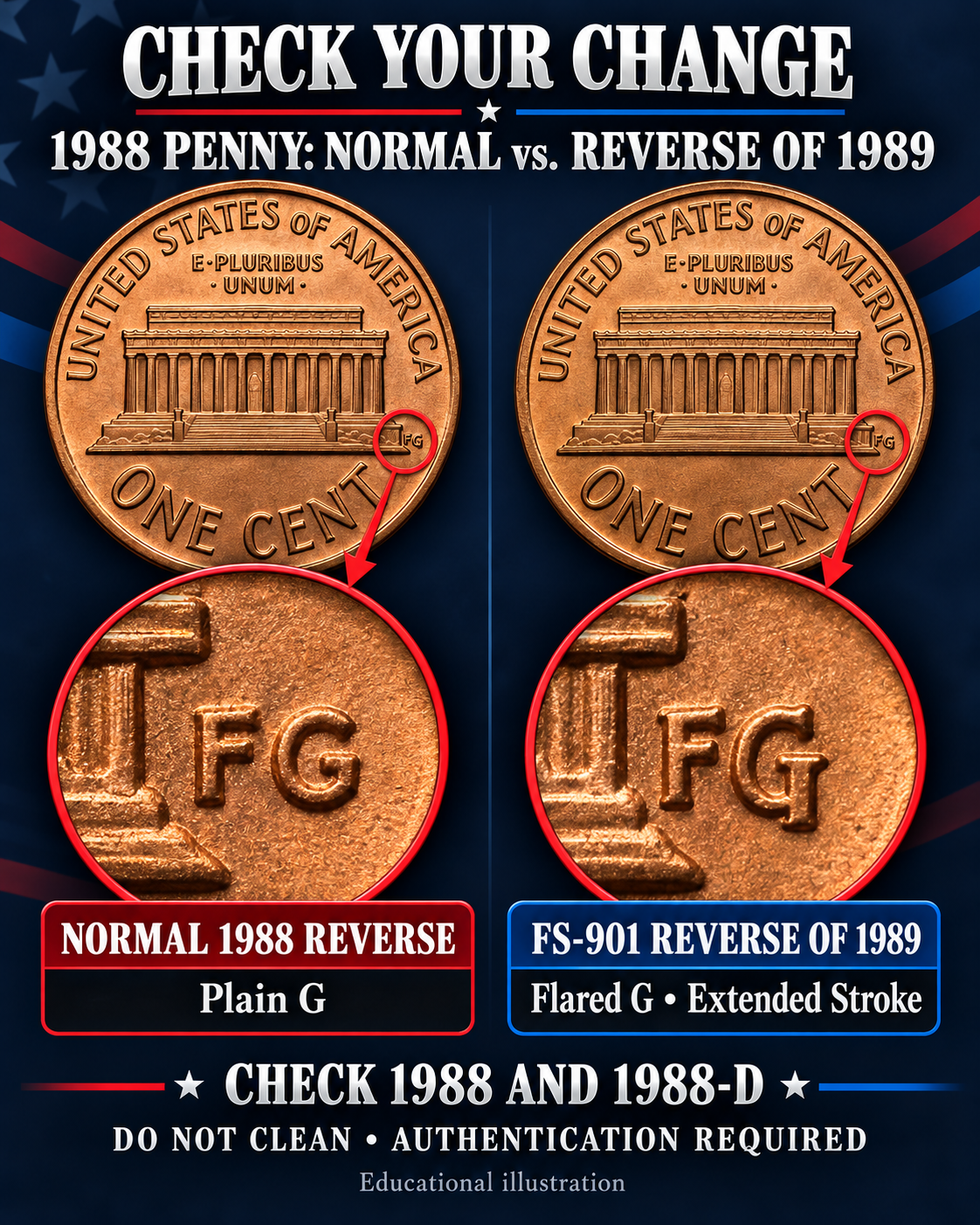
A tiny difference in the designer’s initials can identify a 1988 Lincoln penny struck with a reverse design intended for the following year.
Today’s Check Your Change find is the 1988 or 1988-D Lincoln cent with the Reverse of 1989, cataloged as FS-901 and commonly called the Flared G variety.
What should you look for?
Check Lincoln Memorial pennies dated 1988. Both versions deserve examination:
- 1988 with no mintmark — Philadelphia
- 1988-D — Denver
Turn the penny over and locate the tiny designer’s initials FG immediately to the right of the Lincoln Memorial.
On a normal 1988 penny, the vertical stroke inside the G is plain and does not extend below the lower curve of the letter.
On the FS-901 variety:
- The vertical stroke of the G extends below its lower curve
- A small serif or flare appears near the top of that vertical stroke
- The FG initials appear closer to the Memorial
These features came from the modified reverse hub officially adopted in 1989. Magnification of at least 5× is recommended because the initials are extremely small. PCGS recognizes FS-901 varieties for both Philadelphia and Denver cents, while NGC identifies the design as Reverse of 1989, RDV-006.
Although some holders and older references call it a “Wide AM,” the shape of the G is the most useful diagnostic. Do not rely only on the spacing between the A and M in AMERICA.
How did a 1989 reverse appear early?
The Lincoln Memorial reverse was designed by Frank Gasparro and used from 1959 through 2008. The Mint modified portions of that reverse for 1989, including the designer’s initials. At least one modified reverse die was apparently placed into production early and used to strike pennies dated 1988.
Because the entire reverse came from a different hub design, this is considered a transitional die variety—not circulation damage, machine doubling or an individually altered coin.
How much is a 1988 Reverse of 1989 penny worth?
As of October 2026, authenticated circulated examples may bring approximately $25 to $200, depending on wear, color and whether the coin was struck in Philadelphia or Denver.
Certified uncirculated examples commonly trade from approximately $100 to $600, while particularly high-grade red examples can sell for more. GreatCollections reports Philadelphia brown examples selling from $25 to $232 and red examples from $109 to $1,350. Heritage sold two PCGS MS67 Red Philadelphia examples in 2026 for approximately $598 and $1,037.
The Denver variety can also command substantial premiums. PCGS records a $550 result for an MS63 Red-Brown example, while exceptional certified specimens have sold considerably higher.
These figures are not guaranteed values. Authentication, grade, original color, corrosion, scratches, spots and surface preservation determine what an individual coin is worth.
What should you do if you find one?
Do not clean, polish, rub, scrape or otherwise alter the penny. Cleaning can permanently damage its copper plating and reduce its collector value.
Hold the coin by its edges, photograph both sides and take a sharply focused close-up of the FG initials. Store it in a non-PVC coin flip or capsule and seek professional variety authentication.
Have you found a possible Reverse of 1989 penny—or do you have coins, paper currency or a broader collection? The Patriot Vault may be interested in buying it. Reply to this post and tell us what you have!