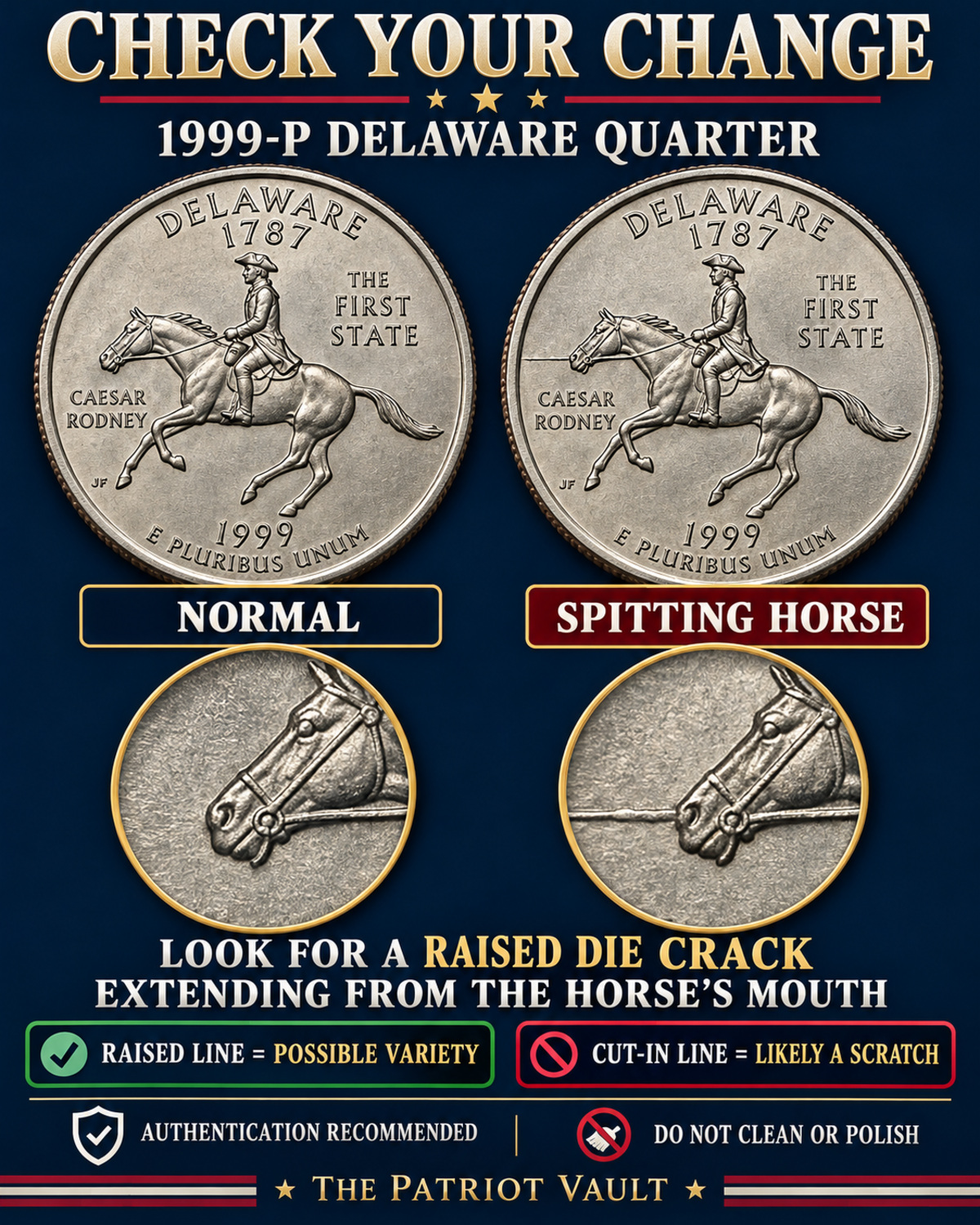

Today’s Check Your Change find is the 1999-P Delaware “Spitting Horse” quarter, a collectible die-crack variety that can still turn up in pocket change, bank rolls and old quarter jars.
What should you look for?
Start with a 1999 Delaware quarter. The reverse features Caesar Rodney riding a horse, with the inscriptions “THE FIRST STATE,” “CAESAR RODNEY” and “DELAWARE.”
Next, check the mintmark on the front. The variety generally identified as the Spitting Horse was struck in Philadelphia and should have a P mintmark.
Using magnification, inspect the area directly in front of the horse’s mouth. On the collectible variety, a thin raised line projects outward from the mouth, making the horse appear to be spitting.
A genuine example should have:
- A 1999 date and P mintmark
- The Delaware reverse with Caesar Rodney on horseback
- A raised line extending from the horse’s mouth
- A line that is part of the coin’s surface—not a cut or scratch
Because circulation damage can create similar-looking marks, authentication is important.
How did the variety happen?
The “spit” is actually a die crack. Coin dies endure tremendous pressure while striking thousands of coins. As a die begins to fracture, metal from the coin blank flows into the crack during striking, leaving a raised line on every coin subsequently produced by that die.
This differs from a scratch, which cuts into the coin’s surface and normally has displaced or exposed metal along its edges.
The Delaware quarter has additional historical significance: released on January 4, 1999, it was the first coin in the U.S. Mint’s 50 State Quarters Program. Its reverse commemorates Caesar Rodney’s 1776 horseback ride to cast Delaware’s deciding vote for independence.
How much is a Spitting Horse quarter worth?
As of October 2026, circulated examples with an identifiable die crack generally sell for approximately $3 to $10. Cleaner coins with a bold, easily visible crack may bring around $10 to $25, while especially attractive or certified examples may sell for more.
These are realistic estimates rather than guaranteed prices. Wear, scratches, stains, cleaning and the strength of the die crack all affect collector interest. Online asking prices are not necessarily completed-sale values.
What should you do if you find one?
Do not clean, polish, rub or scrape the quarter. Hold it by the edges and take clear photographs of both sides, plus a magnified picture of the horse’s mouth.
Place the coin in a non-PVC holder and have the raised line examined before assuming it is the recognized variety.
Have you found a possible Spitting Horse quarter—or do you have coins, currency or a broader collection? The Patriot Vault may be interested in buying it. Reply to this post and tell us what you have!