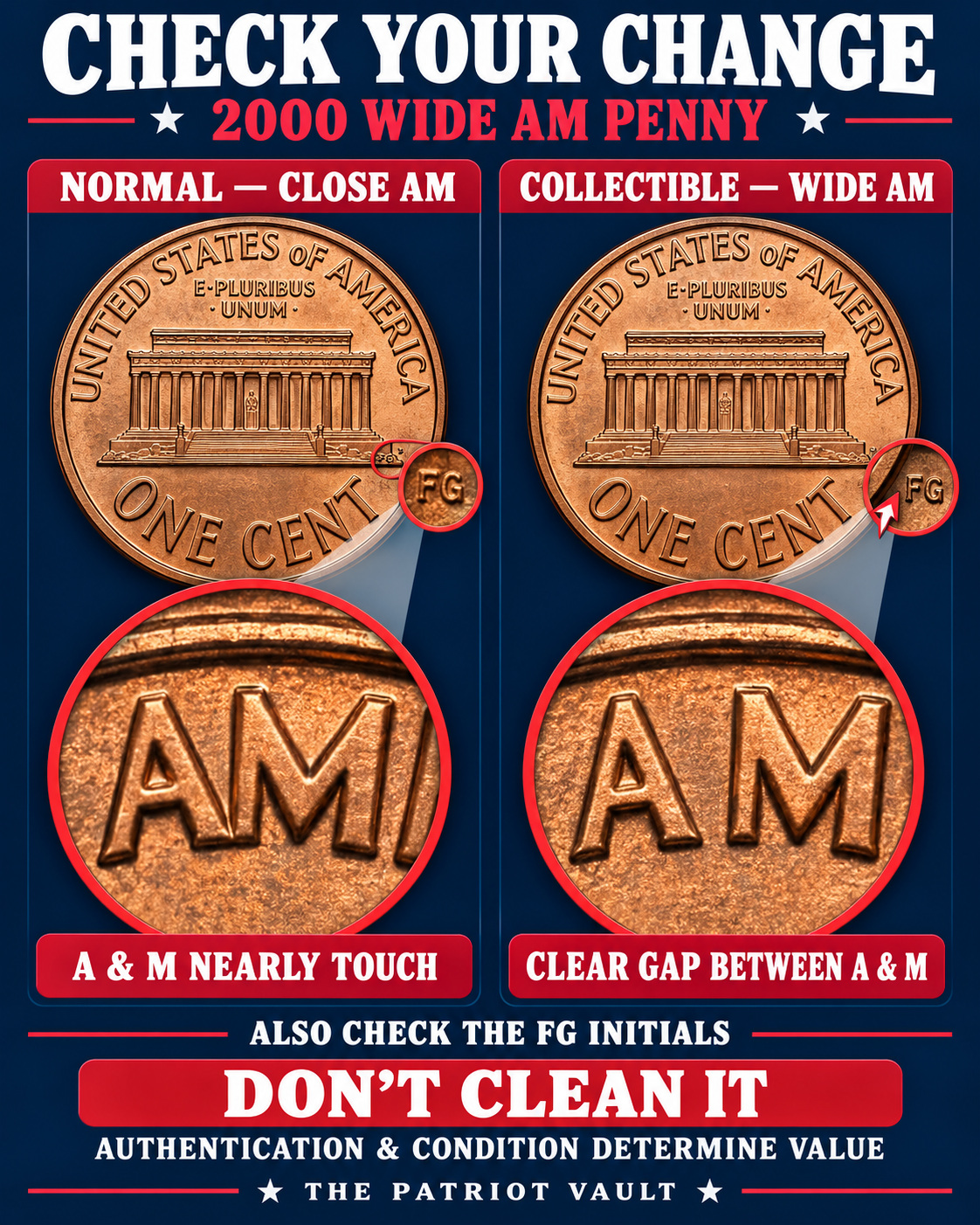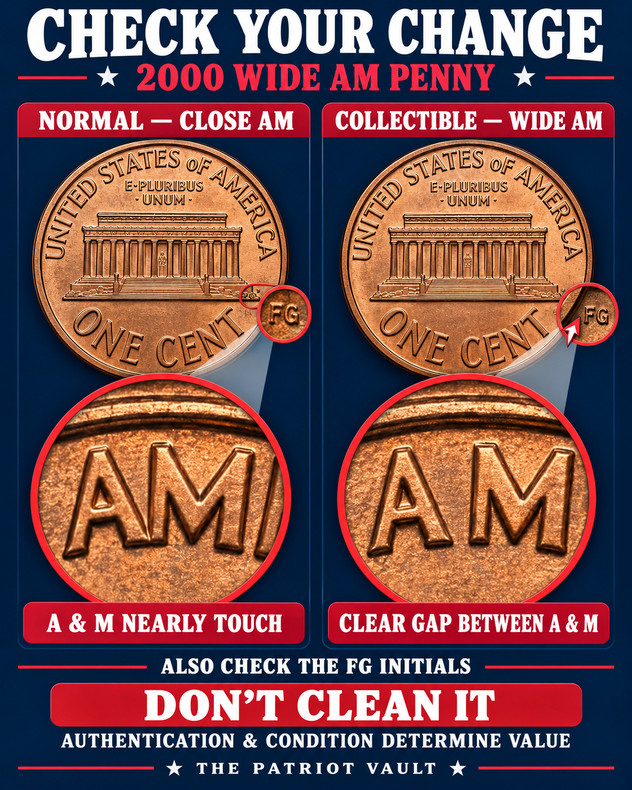
A small gap between two letters can make an ordinary-looking 2000 penny worth considerably more than one cent.
Today’s Check Your Change find is the 2000 Wide AM Lincoln cent, recognized by collectors as FS-901.
What should you look for?
Begin with a Lincoln Memorial penny dated 2000. The collectible Wide AM variety was struck at the Philadelphia Mint, so it should have no mintmark beneath the date. A 2000-D penny is not this variety.
Turn the coin over and examine AMERICA in “UNITED STATES OF AMERICA.”
- Normal 2000 penny: The bottoms of the A and M are extremely close and nearly touch.
- Wide AM variety: A clearly visible space separates the bottoms of the A and M.
Use a 5X or 10X magnifying glass and view the letters straight on. Wear, dirt or corrosion can make the gap difficult to judge.
For additional confirmation, inspect the designer’s initials FG near the Lincoln Memorial. On the Wide AM proof-style reverse, the initials are positioned farther from the Memorial than on the normal circulation reverse. The spacing between the A and M remains the easiest first check.
How was the Wide AM variety created?
Normal circulation-strike cents from this period were supposed to have the Close AM reverse. Proof cents made for collectors used a different reverse on which the A and M were separated.
Some 2000 circulation pennies were accidentally struck with reverse dies carrying the proof-style design. Similar Wide AM circulation varieties are known from 1998 and 1999, but PCGS describes the 2000 issue as the most common of the three.
That comparative availability is good news for change searchers. PCGS estimates that hundreds of thousands may exist and notes that many could remain in circulation.
The variety is officially recognized as FS-901 by PCGS and NGC.
How much is a 2000 Wide AM penny worth?
A genuine circulated example is generally worth approximately $5 to $15, depending on wear and surface quality. Attractive uncirculated examples may bring roughly $10 to $50, while exceptionally well-preserved certified Red coins can command more.
PCGS states that lower-condition examples start around $5. Very high certified grades can be worth hundreds or even thousands, but these exceptional results should not be used to value a typical penny found in change. A PCGS MS68 Red example has an auction record of $2,820, demonstrating how dramatically value can rise at the highest grade levels.
Cleaning, corrosion, spots, scratches and zinc deterioration can substantially reduce the value. Authentication, original color and condition determine what a particular coin is actually worth.
What should you do if you find one?
Do not clean, polish, rub or scrape the penny. Hold it by the edges and photograph both sides. Take a sharp close-up of AMERICA and the FG initials, then place the coin in a non-PVC flip or protective capsule.
Have you found a possible 2000 Wide AM penny—or do you have coins, paper currency or a broader collection? The Patriot Vault may be interested in buying your coin, currency or collection. Reply to this post and tell us what you have!