One of the most distinctive modern Jefferson nickels may still be hiding in pocket change—and the valuable feature is on the opposite side from the coin’s famous handshake design.
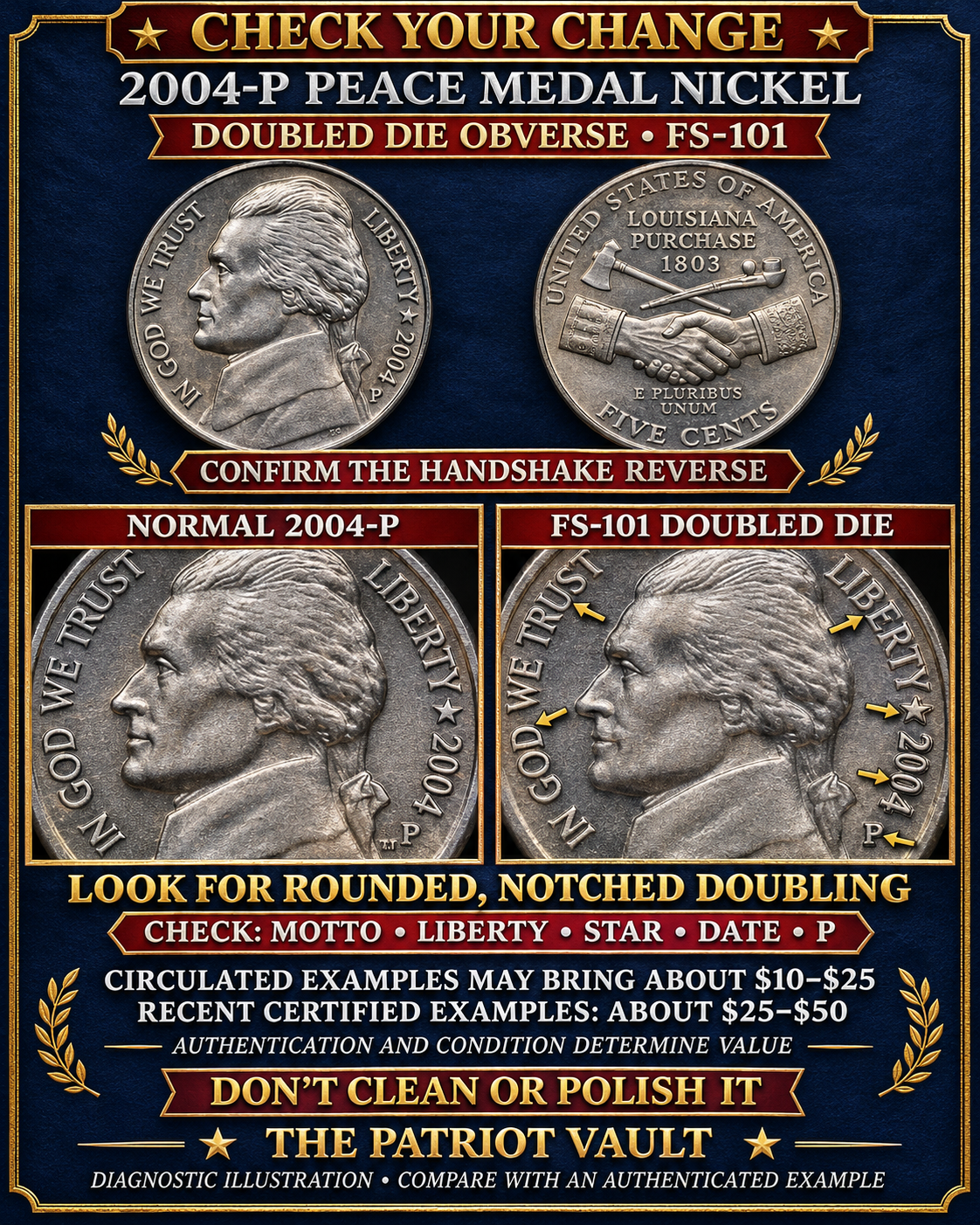
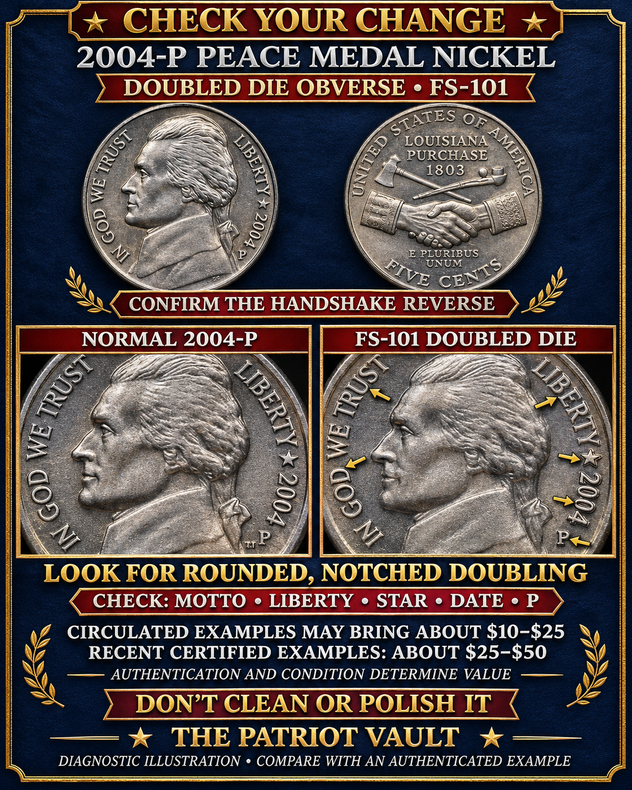
Today’s find is the 2004-P Peace Medal Doubled Die Obverse, cataloged as FS-101 and sometimes called the Handshake Nickel DDO.
What should you look for?
Start with a Jefferson nickel dated 2004-P. The small P mintmark appears near the date on the front.
Turn the coin over and confirm that it has the Peace Medal reverse, featuring two clasped hands beneath crossed symbols. Do not confuse it with the other 2004 design showing Lewis and Clark’s keelboat.
Now examine the front with a magnifying glass. On the genuine FS-101 variety, doubling may appear on:
- IN GOD WE TRUST
- LIBERTY
- The star between LIBERTY and the date
- The numerals in 2004
- The P mintmark
- Portions of Jefferson’s portrait and the designer’s initials
Look for rounded secondary impressions and small notches around the letters and numerals. Flat, shelf-like spreading is usually mechanical doubling rather than the recognized doubled-die variety. Comparing the coin with authenticated photographs is important because ordinary strike deterioration and machine doubling can look convincing.
NGC recognizes the variety as 2004-P Handshake DDO FS-101, while PCGS lists it as the 2004-P DDO FS-101 Peace Medal.
Why is the Peace Medal nickel special?
The United States Mint introduced the Westward Journey Nickel Series in 2004 to commemorate the bicentennials of the Louisiana Purchase and the Lewis and Clark expedition.
The Peace Medal nickel was the first design in the series and the first major redesign of the circulating nickel in 66 years. Its reverse was adapted from the Jefferson Peace Medal designed in 1801. Lewis and Clark presented similar medals as tokens of goodwill during their expedition. The coins entered circulation in March 2004.
A doubled die originates during die production. Misalignment while the design is being transferred to a working die can create doubled design elements. Every coin struck from that die carries the same characteristic doubling.
How much is a 2004-P doubled-die nickel worth?
This variety is collectible, but realistic values are more modest than some online headlines suggest.
Recent GreatCollections records show certified MS62 through MS65 examples selling for approximately $25 to $39. PCGS records include older certified sales ranging from approximately $31 to $185, depending on grade, attribution and market conditions.
A clearly attributable circulated example might reasonably be worth approximately $10 to $25. Attractive uncirculated or certified examples may bring roughly $25 to $50, with exceptional coins sometimes selling for more.
These figures are estimates—not guaranteed prices. Strength of the doubling, wear, scratches, spots, cleaning and authentication all affect value. Ordinary 2004-P Peace Medal nickels remain worth five cents unless they have the recognized variety or another collectible feature.
What should you do if you find one?
Do not clean, polish, rub, scrape or chemically treat the nickel. Hold it by the edges and photograph both sides. Take sharp close-ups of the date, mintmark, LIBERTY and IN GOD WE TRUST.
Place it in a non-PVC flip or capsule and consider professional attribution if the doubling matches authenticated FS-101 examples.
Have you found a possible 2004-P doubled die—or do you have coins, currency or a broader collection? The Patriot Vault may be interested in buying your coin, currency or collection. Reply to this post and tell us what you have!