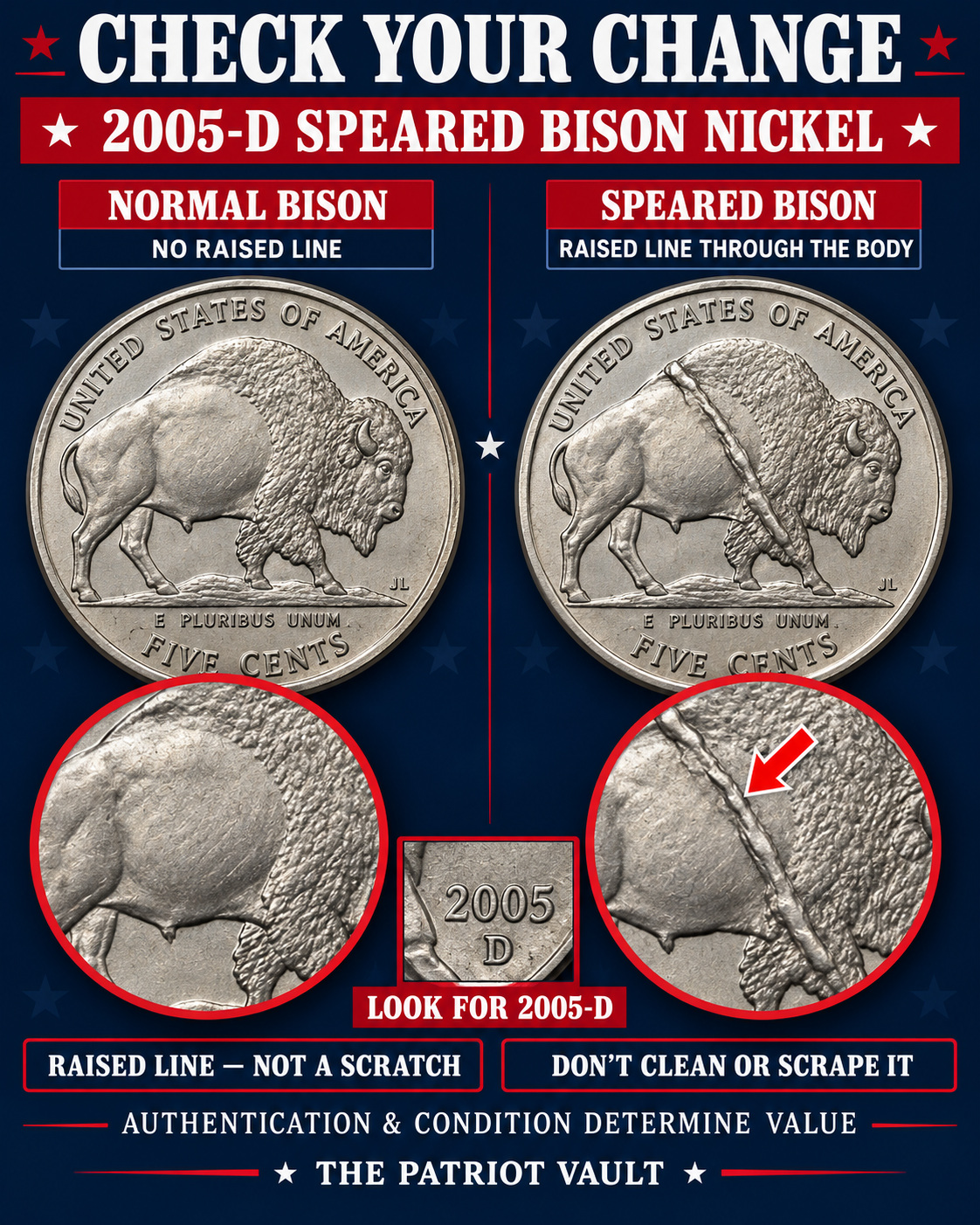
A dramatic raised line across the bison can turn an ordinary-looking 2005 nickel into a collectible worth considerably more than five cents.
Today’s Check Your Change find is the 2005-D Speared Bison Jefferson nickel, a modern die variety that can still appear in pocket change, bank rolls and old coin jars.
What should you look for?
Begin with a 2005 Jefferson nickel featuring an American bison on the back. Two different nickel reverses were released that year, so make sure yours has the bison—not the “Ocean in View” design.
Check the front for a D mintmark, indicating that the coin was struck at the Denver Mint.
Next, examine the bison on the reverse. A genuine Speared Bison displays a prominent raised line running diagonally through the bison’s back and body. The line creates the appearance of a spear passing through the animal.
The word raised is important. A scratch received after the coin left the Mint cuts into the surface and removes or displaces metal. The collectible variety has a line raised above the surrounding surface because the defect was present on the die that struck the coin.
Use a magnifying glass and tilt the nickel beneath a light. If the suspected line appears recessed, irregular or accompanied by scraped metal, it is probably ordinary damage.
How did the Speared Bison variety happen?
The American bison reverse was part of the Westward Journey nickel program commemorating the Louisiana Purchase and the Lewis and Clark expedition. The design was used for only part of 2005.
On some Denver dies, a severe break or gouge developed during production. Metal from each coin flowed into the damaged area of the die, creating the same raised “spear” on every nickel struck from it.
PCGS recognizes the Speared Bison as a major Jefferson nickel variety and assigns it its own catalog number, PCGS #84159.
How much is a 2005-D Speared Bison nickel worth?
Value depends heavily on whether the line is genuine, how clearly it appears and the coin’s condition.
PCGS reports that moderately circulated examples can trade for more than $50. Worn or damaged examples may bring less, while attractive uncirculated coins can be worth approximately $100 to $400 or more.
Recent documented auction results include approximately $149 for a certified MS63 example and $456 for a certified MS65 example. Exceptional MS66 coins have sold for substantially more, but those results should not be treated as typical values for nickels found in circulation.
Authentication is particularly important because ordinary scratches can resemble the variety in photographs. Surface marks, discoloration, corrosion, cleaning and wear can also reduce value.
What should you do if you find one?
Do not clean, polish, scrape or attempt to test the line with a tool. Hold the nickel by its edges and take sharp photographs of both sides. Include a close-up showing the entire raised line across the bison.
Place the coin in a non-PVC flip or protective capsule and consider professional attribution before offering it for sale.
Have you found a possible Speared Bison—or do you have coins, paper currency or a broader collection? The Patriot Vault may be interested in buying your coin, currency or collection. Reply to this post and tell us what you have!