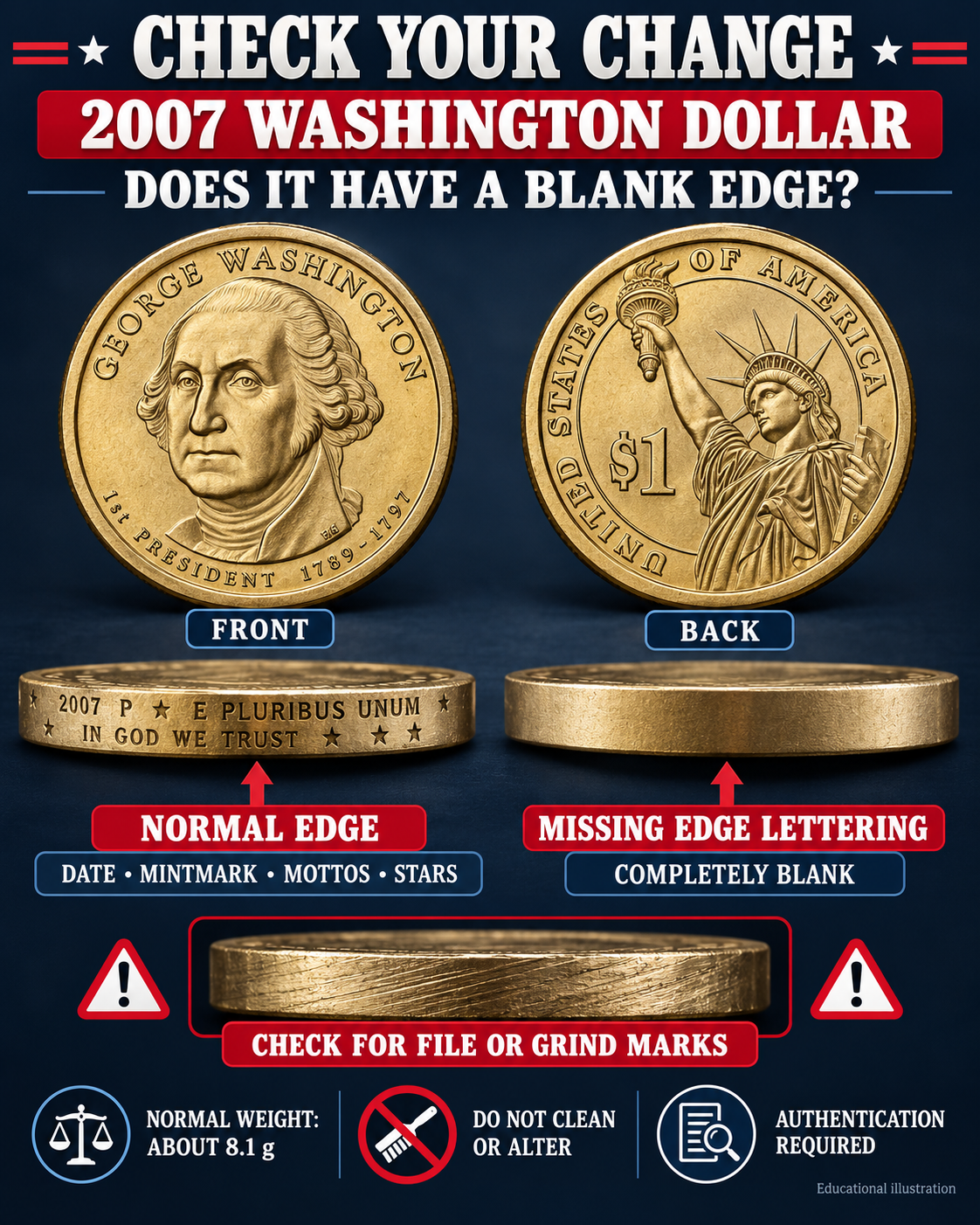
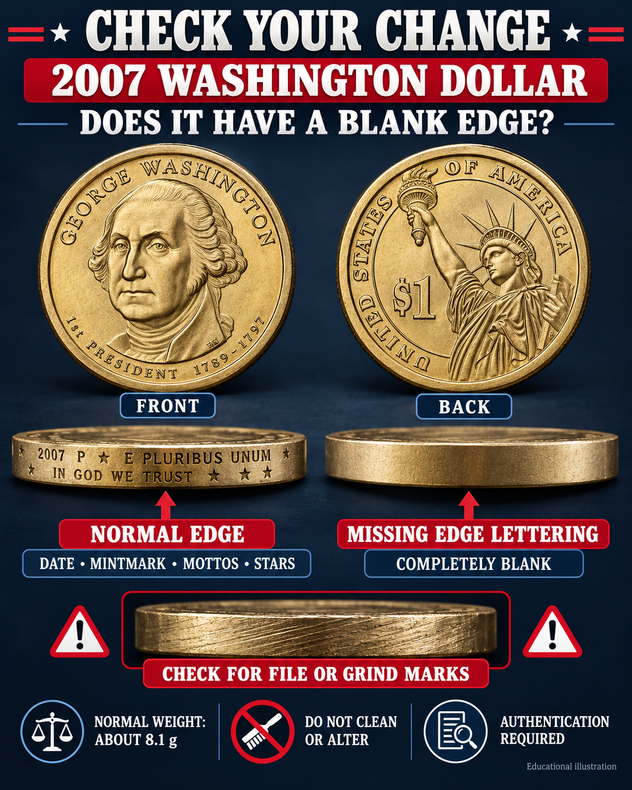
A golden-colored George Washington dollar may be worth more than one dollar if its edge is completely blank.
Today’s Check Your Change find is the 2007 George Washington Presidential dollar with missing edge lettering, one of the best-known errors from the Presidential $1 Coin Program.
What should you look for?
Begin with a Presidential dollar featuring George Washington on the front and the Statue of Liberty on the back.
Next, hold the coin sideways and inspect its edge. A normal 2007 Washington dollar should display:
- 2007
- A P or D mintmark
- E PLURIBUS UNUM
- IN GOD WE TRUST
- Decorative stars
On the genuine error, the entire edge is plain. Because both the date and mintmark were supposed to appear on the edge, a missing-edge example appears completely dateless and mintmark-free.
Do not confuse this error with ordinary weak, partial or upside-down edge lettering. The inscriptions were applied randomly, so their orientation relative to Washington’s portrait does not affect value.
Also examine the edge for grinding or filing. Someone can remove lettering from an ordinary coin, but that creates an altered coin—not a Mint error. A genuine example should retain its normal diameter, weight and rounded edge without suspicious tool marks. The standard coin weighs approximately 8.07 grams and measures 26.5 millimeters. Authentication is especially important for raw examples.
How did the edge lettering disappear?
The Washington dollar was the first coin released in the Presidential $1 Coin Program on February 15, 2007.
The coin’s front and back were struck first. Edge inscriptions were added afterward in a separate operation. Some coins skipped that second step and went directly into bags for circulation, leaving their edges completely blank.
In March 2007, the U.S. Mint confirmed that an unspecified quantity of Philadelphia coins had inadvertently entered circulation without edge lettering. NGC reports that hundreds of thousands may have been produced, making the error collectible but not extremely rare.
The omission attracted widespread attention because IN GOD WE TRUST was among the missing inscriptions. Congress later required the motto to be moved from the edge to the obverse or reverse of subsequent Presidential dollars.
How much is a missing-edge Washington dollar worth?
As of November 2026, genuine circulated examples may trade for approximately $10 to $25, although uncertified coins can be difficult to sell confidently because edge lettering can be removed artificially.
Typical certified uncirculated examples generally bring approximately $25 to $75, depending on grade and appearance. NGC’s current guide lists values ranging from about $35 in MS60 to $90 in MS66. Recent auction results include an MS66 example sold for $45 in April 2025 and another for $50 in July 2026.
Exceptionally high-grade coins can bring more, but early four-figure results should not be treated as typical current values. Authentication, grade, scratches, spotting, discoloration and edge preservation determine actual value.
What should you do if you find one?
Do not clean, polish, file, sand or otherwise alter the coin. Never scrape the edge to “test” it.
Photograph the front, back and complete edge. Weigh it with a scale accurate to at least 0.1 gram, then place it in a non-PVC flip or capsule. Consider professional authentication before offering it for sale.
Have you found a blank-edge Washington dollar—or do you have coins, paper currency or a broader collection? The Patriot Vault may be interested in buying it. Reply to this post and tell us what you have!