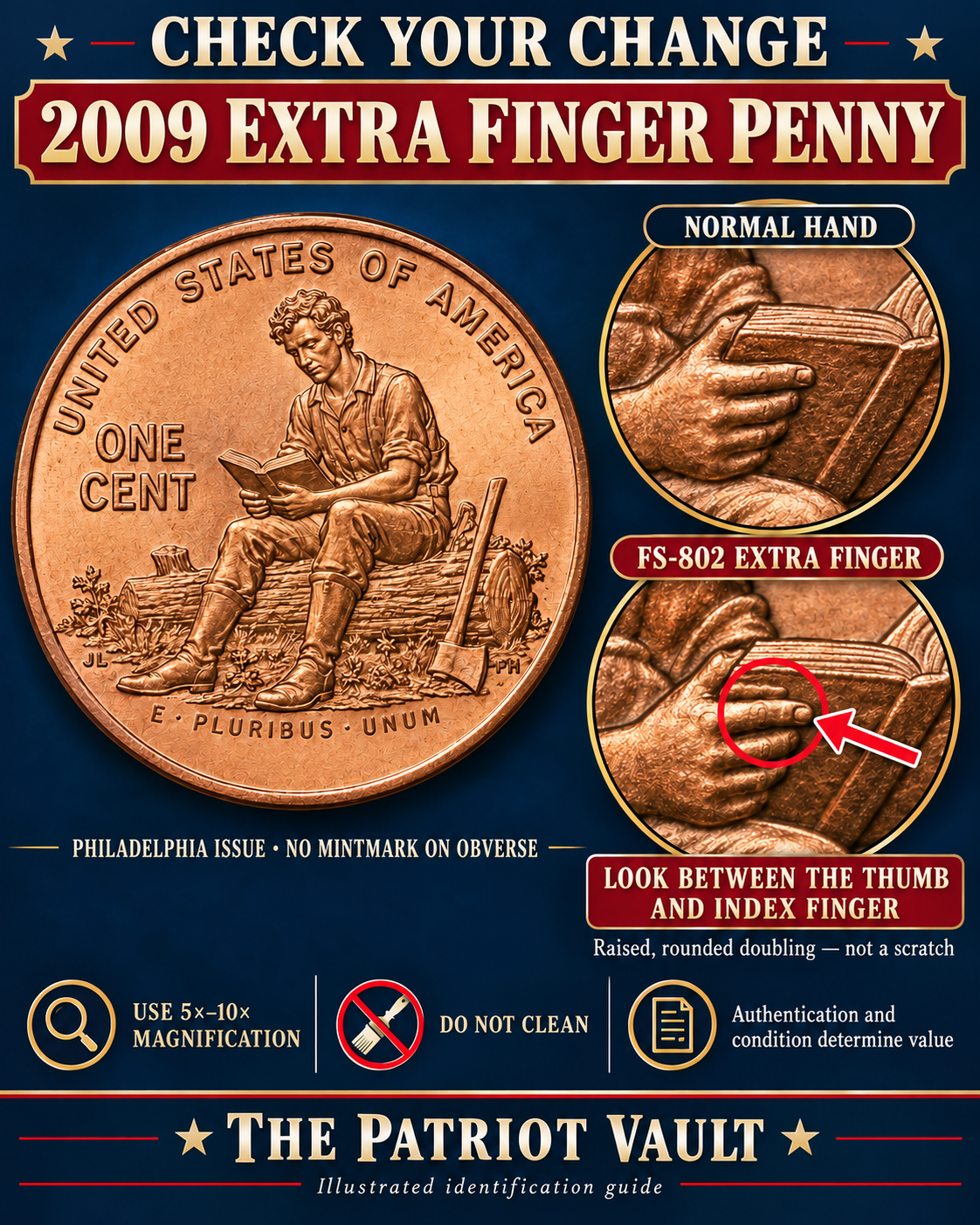
Most 2009 pennies are worth one cent, but a distinctive doubled-die variety can show what appears to be an extra finger on Abraham Lincoln’s hand.
Today’s Check Your Change find is the 2009 Formative Years Lincoln cent Doubled Die Reverse, FS-802.
What should you look for?
First, find a 2009 penny with the Formative Years in Indiana design. The reverse shows a young Abraham Lincoln sitting on a log, reading a book during a break from rail splitting.
The FS-802 variety was struck in Philadelphia and has no mintmark beneath the date. A 2009-D penny is not this particular variety.
Turn the penny over and examine the hand holding the open book. On a genuine FS-802 coin, doubling creates a strong, separated extra finger between Lincoln’s normal thumb and index finger.
Use at least 5× to 10× magnification. The extra feature should look raised and rounded, like part of the original design. A scratch, stain, plating bubble or flat shelf of displaced metal is not sufficient evidence of the variety.
More than 100 doubled-die varieties have been cataloged for this reverse, but many are minor. PCGS recognizes eight varieties listed in the Cherrypickers’ Guide, so precise attribution matters.
Why does this penny have an extra finger?
A doubled die is created while the coin die is being manufactured. A small misalignment in the design-transfer process can place part of the image in two slightly different positions. Every coin struck by that die then carries the same doubled feature.
This is different from damage occurring after the coin left the Mint.
The Formative Years penny was the second of four Lincoln Bicentennial designs released in 2009. It represents Lincoln’s life in Indiana from 1816 through 1830. The Philadelphia Mint produced approximately 376 million examples of the regular design, although only a small fraction were struck by the FS-802 doubled die.
How much is the FS-802 penny worth?
Value depends heavily on correct attribution, color and surface condition.
Recent uncertified FS-802 examples have sold for approximately $9 to $10, while certified Red examples in roughly MS65–MS66 condition have produced results ranging from about $50 to $225.
An exceptional PCGS MS67 Red example sold for $2,750 in June 2020, but that was a top-population auction result—not a typical value for a penny found in change.
Wear, dark spots, corrosion, scratches and zinc-plating damage can reduce value substantially. Authentication, the specific doubled-die attribution and condition determine the actual market value.
What should you do if you find one?
Do not clean, polish, rub, scrape or chemically treat the penny. Cleaning cannot improve its grade and may permanently reduce its collector value.
Hold it by the edges, photograph both sides and take a sharp close-up of Lincoln’s hand. Store it in a non-PVC coin flip or protective capsule. Consider professional attribution if the extra finger matches an authenticated FS-802 example.
Have you found a possible Extra Finger penny—or do you have coins, paper currency or a larger collection? The Patriot Vault may be interested in buying your coin, currency or broader collection. Reply to this post and tell us what you have!