Some ordinary-looking one-dollar bills were produced on an experimental printing press—and a tiny number on the back can identify them.
Today’s Check Your Change find is the $1 Web Note, produced in Series 1988A, 1993 and 1995.
What should you look for?
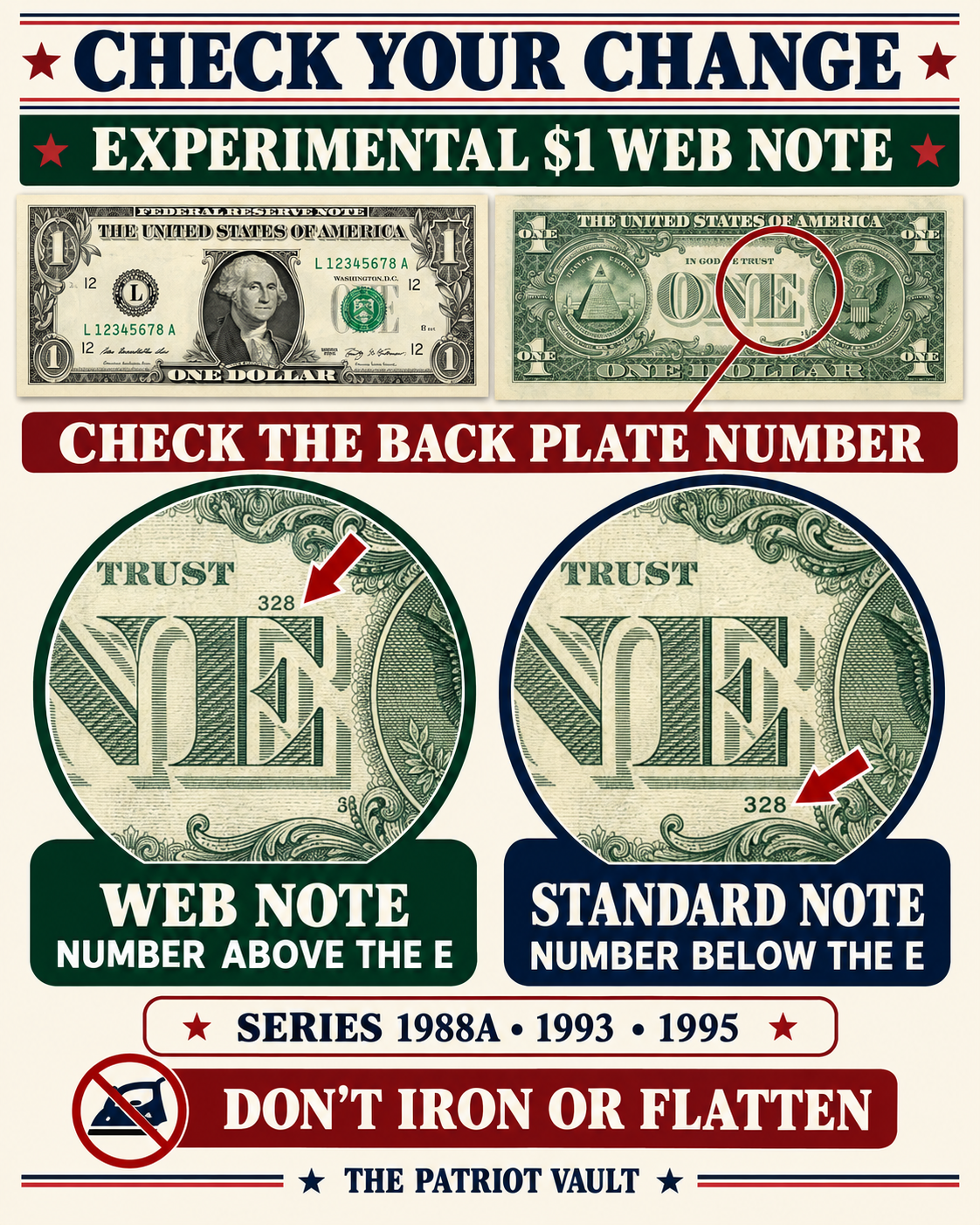
Begin by checking the series designation on the front of the bill near George Washington’s portrait. Only examine notes marked:
- Series 1988A
- Series 1993
- Series 1995
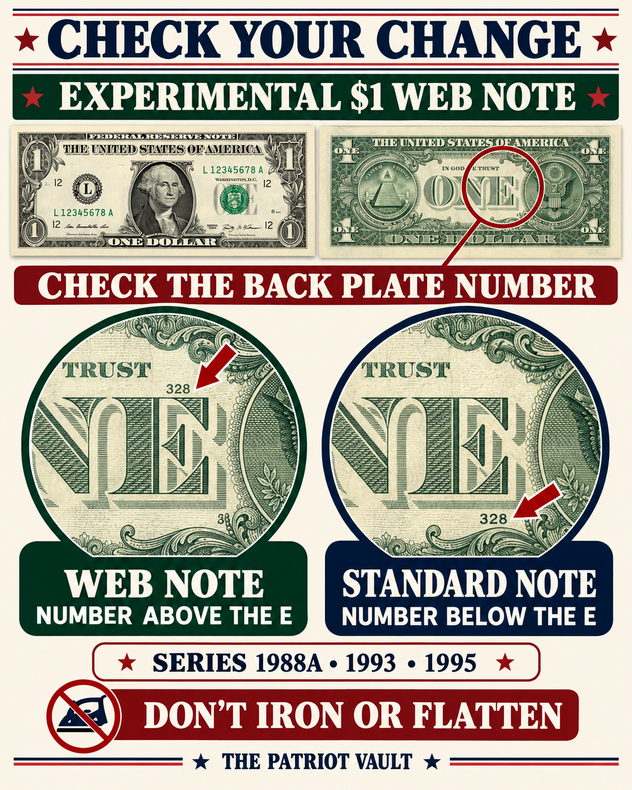
Next, turn the bill over and look at the large word ONE in the center. Find the small back plate number near the letter E:
- Web Note: The plate number is positioned above the E in ONE and to the right of TRUST.
- Standard note: The plate number is positioned below the E in ONE.
That location is the easiest identification feature.
There are also differences on the front. Web Notes lack the usual face plate-position number and check letter in the upper-left area. Their lower-right face plate number consists only of numerals, without the letter normally placed before it. The back plate-number position is generally easier for beginners to recognize.
Why were Web Notes produced?
In 1992, the Bureau of Engraving and Printing began testing an experimental press that printed currency on a continuous roll—or “web”—of paper. Standard currency presses printed separate sheets.
The goal was to determine whether continuous-roll printing could produce currency more quickly and economically. Only one-dollar bills were used for the experiment.
Series 1988A Web Notes entered circulation first, followed by certain Series 1993 and 1995 notes. The experiment continued until 1996, but the press did not prove as efficient as existing sheet-fed equipment.
Web Notes are not printing errors or counterfeits. They are genuine Federal Reserve notes manufactured by a different experimental process.
How much is a $1 Web Note worth?
Value depends on the series, Federal Reserve district, serial-number block and condition.
As of October 2026, many ordinary circulated Web Notes from commonly encountered production runs are estimated at approximately $5 to $15. Cleaner examples from better runs may bring around $10 to $30, while crisp uncirculated notes can be worth more.
Certain Series 1988A notes are considerably scarcer. The important New York B–L block and Atlanta star notes have been estimated at several hundred dollars in circulated condition, with exceptional uncirculated examples potentially exceeding $1,000.
Those scarce blocks should not be confused with typical Web Notes. Exact serial-number ranges must be checked, and online asking prices are not guaranteed market values. Condition, rarity and authentication determine the actual value.
What should you do if you find one?
Do not wash, iron, press, flatten, laminate or tape the bill. Handle it with clean, dry hands and photograph both sides, including the series, complete serial number and plate numbers.
Store it flat in an archival-quality, PVC-free currency sleeve. If it belongs to a potentially scarce serial-number block, have it evaluated before selling it.
Have you found a Web Note—or do you have old coins, paper currency or a larger collection? The Patriot Vault may be interested in buying your coin, currency or broader collection. Reply to this post and tell us what you have!