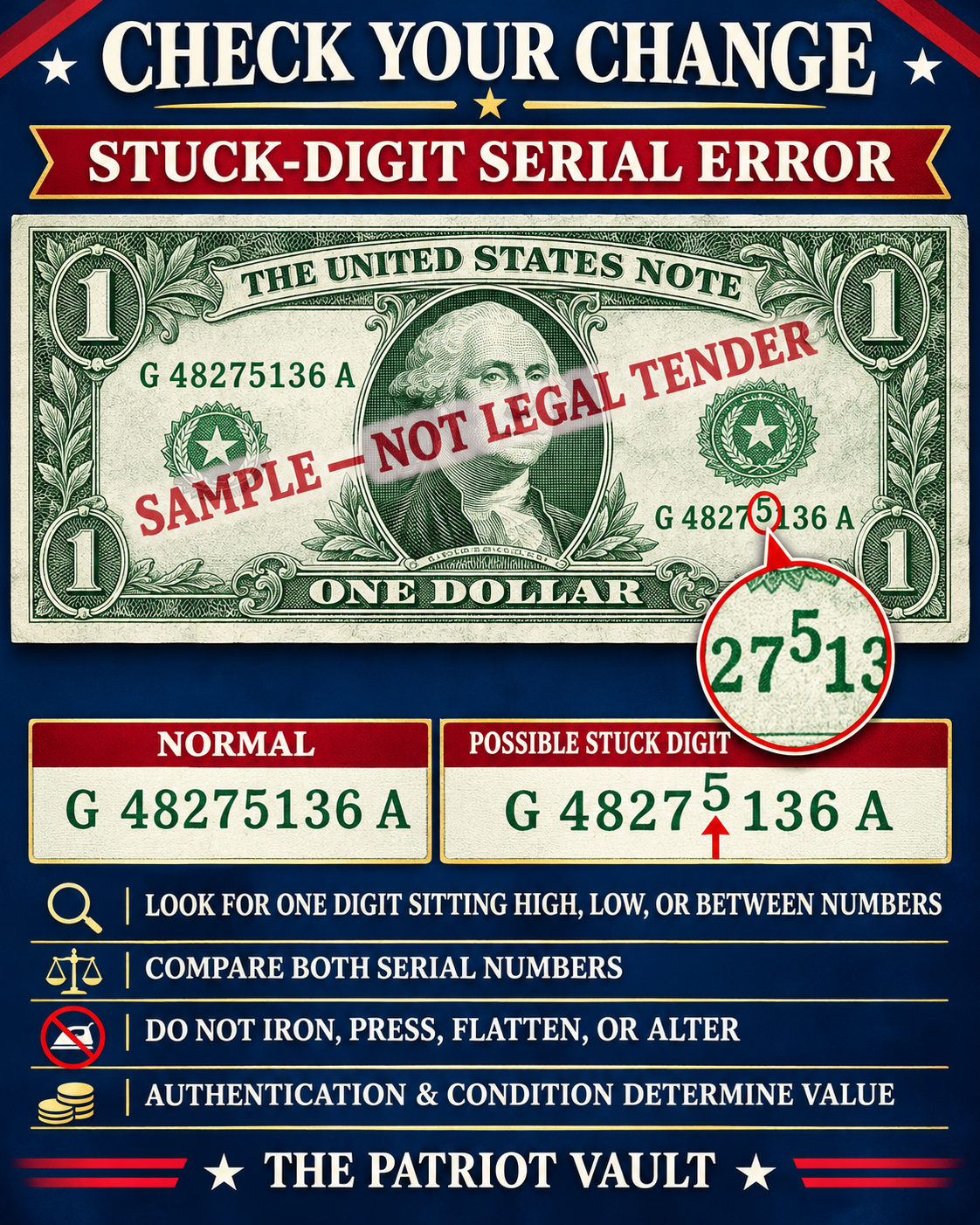
Most people glance at a bill’s denomination and never examine its serial numbers. One noticeably raised or lowered digit, however, may identify a collectible stuck-digit error, also known as a gas-pump error.
What should you look for?
Examine both serial numbers on the front of every bill. On genuine Federal Reserve notes, the same unique serial number normally appears twice.
Look for a digit that:
- Sits conspicuously higher or lower than the remaining characters
- Appears partly cut off
- Shows portions of two numbers—for example, the top of a 2 and the bottom of a 1
- Is affected in one serial number while the corresponding serial number is printed normally
A modest difference in alignment is not necessarily collectible. Mechanical numbering can produce small variations. A convincing stuck-digit error should be obvious and may show the numbering wheel caught between two positions.
Compare the affected serial number with the second one. If every digit is fully formed but the two serial numbers disagree, that is a mismatched serial-number error, not simply a stuck digit.
How does the error happen?
The Bureau of Engraving and Printing applies serial numbers, Treasury seals and other identifiers during its overprinting process.
PMG explains that a stuck-digit error occurs when a numbering wheel advances only partially—or moves slightly too far—before printing. This can leave a digit out of line and reveal part of an adjacent number on the wheel. The nickname “gas pump” comes from the tumbling number displays once commonly seen on mechanical fuel pumps.
Because these errors can occur on ordinary denominations, an overlooked example could remain in a cash drawer, wallet or bank strap.
How much is a stuck-digit bill worth?
Value depends on how dramatic the displacement is, the note’s denomination and series, its condition, and whether the error has been authenticated.
As a practical November 2026 guide:
- Minor but unmistakable examples may trade around $50–$150
- More dramatic or certified examples may bring approximately $150–$500
- Notes combining a stuck digit with another major error, a star designation or unusual type can bring more
Completed auctions illustrate the variation. Two certified uncirculated 1969D $1 notes sold together for $288 in October 2024, while a circulated 1963B $1 note with several stuck digits realized $336 in August 2025. A certified uncirculated 1969A $20 star note brought $480 in August 2025.
These results are comparisons, not guaranteed prices. A barely misaligned digit may carry little or no premium, while a clear authenticated error may attract stronger demand.
What should you do if you find one?
Do not wash, iron, press, flatten, erase, trim, tape or otherwise alter the bill. Repairs and attempts to improve its appearance can damage the paper and reduce its value.
Photograph the entire front and back, then take close-ups of both serial numbers. Store the note flat in an archival-quality, PVC-free currency sleeve. For a clear or potentially valuable example, consider professional authentication before selling it.
Have you found an unusual serial number—or do you have coins, paper currency or a larger collection? The Patriot Vault may be interested in buying your bill, coin, currency or broader collection. Reply to this post and tell us what you have!