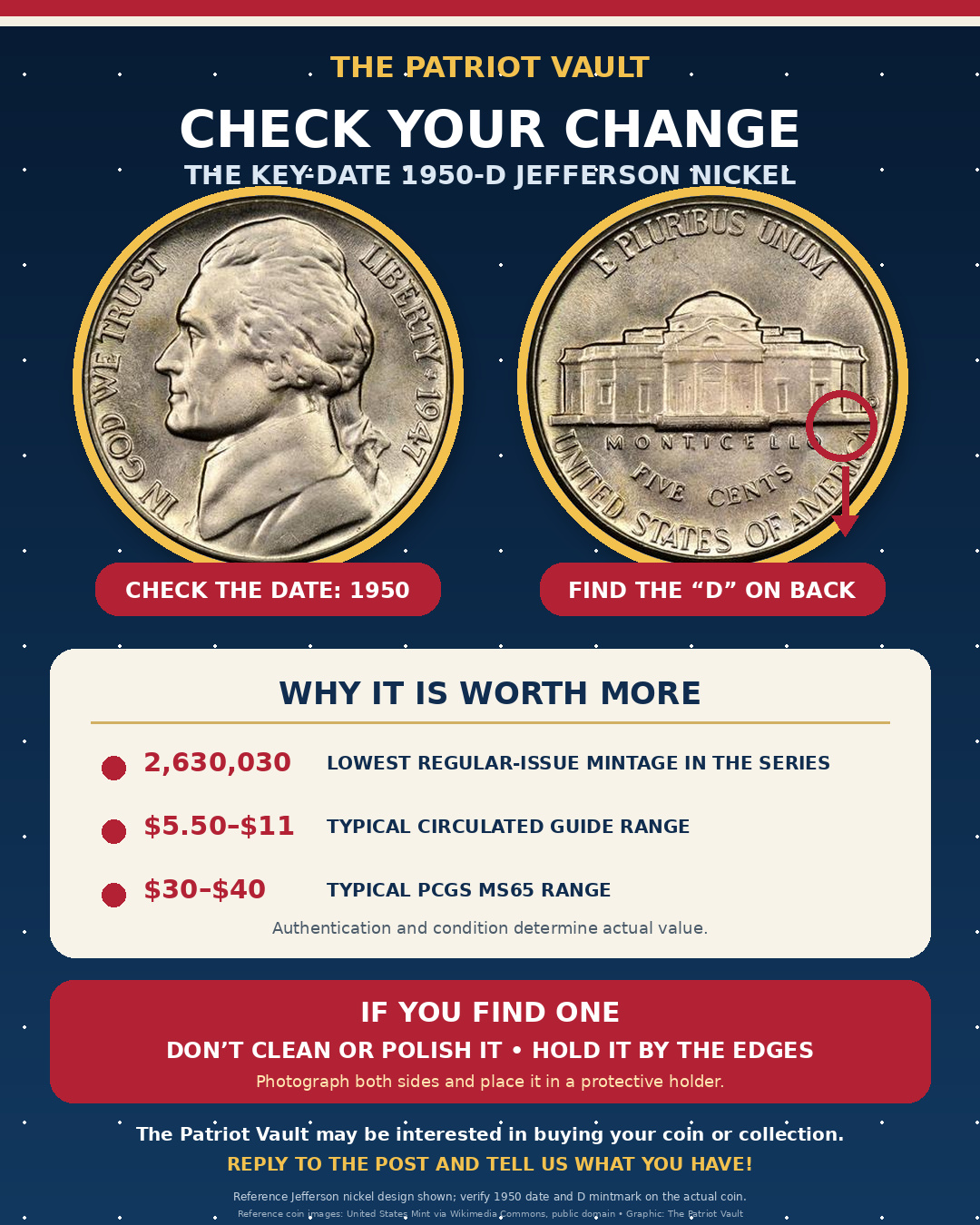
An old Jefferson nickel may be worth considerably more than five cents—especially if it carries the date 1950 and a small D mintmark.
Today’s Check Your Change find is the 1950-D Jefferson nickel, the lowest-mintage regular-issue coin in the entire Jefferson nickel series.
What should you look for?
Begin by examining the date beside Thomas Jefferson’s portrait. You are looking specifically for 1950.
Next, turn the nickel over and inspect the area immediately to the right of Monticello. A small D mintmark identifies a coin struck at the Denver Mint.
Both details must be present:
- Date: 1950
- Mintmark: D
- Mintmark location: To the right of Monticello on the reverse
A 1950 nickel without a mintmark was produced in Philadelphia and is considerably more common. NGC’s September 2026 guide values ordinary circulated Philadelphia examples at only about 10 to 20 cents, compared with several dollars for a genuine 1950-D.
Do not confuse the 1950-D with a wartime silver nickel. The 1950-D has the normal copper-nickel composition and a small mintmark beside Monticello—not the oversized mintmark above the building found on 1942–1945 silver nickels.
Why is the 1950-D special?
The Denver Mint produced only 2,630,030 Jefferson nickels in 1950. That was the smallest nickel mintage since 1931 and remains the lowest regular-issue mintage in the Jefferson nickel series.
Collectors quickly noticed the low production total and began saving the coins in rolls. During the 1950s and early 1960s, heavy promotion helped create a speculative market for the 1950-D.
Although many uncirculated examples were preserved, genuinely circulated coins are less frequently encountered. PCGS notes that finding a worn 1950-D can actually be more unusual than encountering a preserved Mint State example.
How much is a 1950-D nickel worth?
According to the NGC Price Guide in September 2026, an ordinary circulated 1950-D Jefferson nickel is generally valued at approximately $5.50 to $11, depending on wear and overall condition.
Typical certified examples around MS65 may bring approximately $30 to $40. Sharply struck coins displaying five or six complete steps at the base of Monticello can command additional premiums, particularly in exceptional grades.
These figures are estimates rather than guaranteed selling prices. Scratches, corrosion, discoloration, rim damage and cleaning can reduce the value. Authentication and condition determine what an individual coin is actually worth.
What should you do if you find one?
Do not clean, polish, scrub or chemically treat the nickel. Cleaning can leave permanent surface damage and remove any collector premium.
Hold the coin by its edges, photograph both sides and take a close-up of the date and mintmark. Place it in a non-PVC coin flip or protective capsule.
Have you found a 1950-D nickel—or do you have coins, paper currency or a larger collection? The Patriot Vault may be interested in buying your coin, currency or broader collection. Reply to this post and tell us what you have!