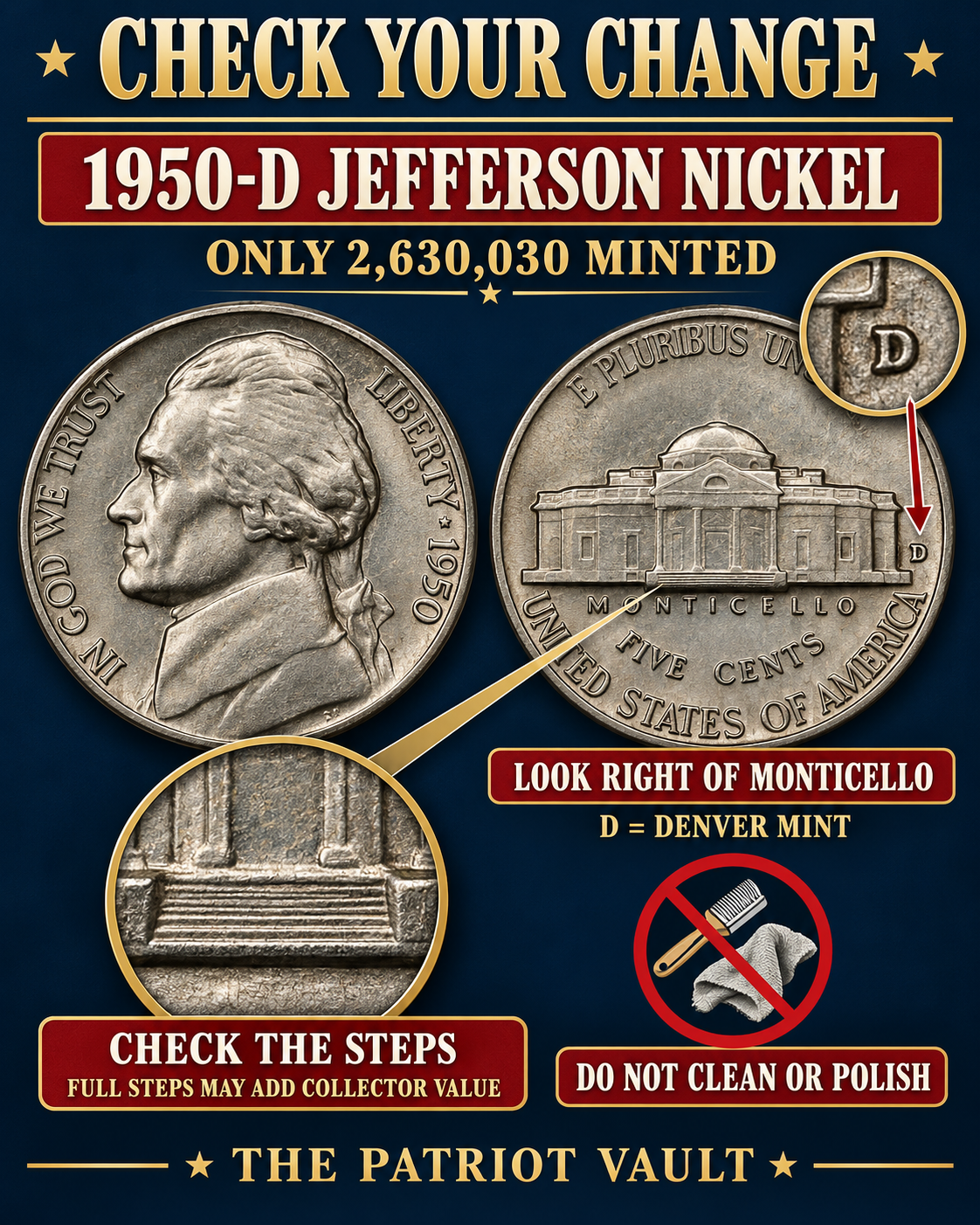
Check Your Change: The Low-Mintage 1950-D Jefferson Nickel
A five-cent coin dated 1950 could be worth considerably more than face value—but only if it carries the correct mintmark.
Today’s Check Your Change find is the 1950-D Jefferson nickel, a famous low-mintage issue that remains possible—though difficult—to find in old change, bank rolls, coin jars and inherited collections.
What should you look for?
Begin by checking the date beside Thomas Jefferson’s portrait. It must read 1950.
Next, turn the coin over and inspect the area immediately to the right of Monticello. Look for a small D mintmark, indicating that the coin was struck at the Denver Mint.
A 1950 nickel without a mintmark was made in Philadelphia and is much more common. There were no 1950-S circulation-strike nickels.
The identifying combination is therefore:
- 1950 date
- Small D to the right of Monticello
- Original Jefferson-and-Monticello design
- Plain, non-reeded edge
Do not confuse scratches, corrosion or discoloration with a mintmark. Magnification or a sharply focused photograph can help confirm the letter.
Why is the 1950-D nickel special?
The Denver Mint produced only 2,630,030 Jefferson nickels in 1950—the lowest regular-issue mintage in the Jefferson nickel series.
When collectors learned how few had been made, dealers and speculators began saving rolls and bags. This created an unusual situation: many examples survived in uncirculated condition, while genuinely circulated examples are comparatively difficult to encounter.
NGC notes that collectors aggressively saved the coin after its final mintage became known. PCGS explains that the resulting speculation eventually became a market bubble, so the coin is collectible but not the great rarity it was once advertised to be.
How much is a 1950-D nickel worth?
As of October 2026, worn examples commonly have a retail value of approximately $5 to $15, depending on wear, surface quality and eye appeal.
Uncirculated examples generally bring approximately $15 to $40. PCGS reports that a typical certified MS65 example may sell for around $30 to $40. Exceptionally well-struck coins displaying five or six complete, uninterrupted steps beneath Monticello can receive the Full Steps designation and may bring more.
Heavy scratches, corrosion, stains, rim damage and cleaning can reduce the value. Certification may be worthwhile for an unusually sharp, high-grade example, but it is not automatically cost-effective for every coin. Authentication and condition determine the actual market value.
What should you do if you find one?
Do not clean, polish, scrub, dip or attempt to brighten it. Cleaning permanently alters the surface and can reduce collector interest.
Hold the coin by its edges, photograph both sides and take a close-up of the date and D mintmark. Store it in a non-PVC coin flip or protective capsule. If the coin appears uncirculated, also photograph the steps below Monticello.
Have you found a 1950-D nickel—or do you have coins, paper currency or a broader collection? The Patriot Vault may be interested in buying your coin, currency or collection. Reply to this post and tell us what you have!