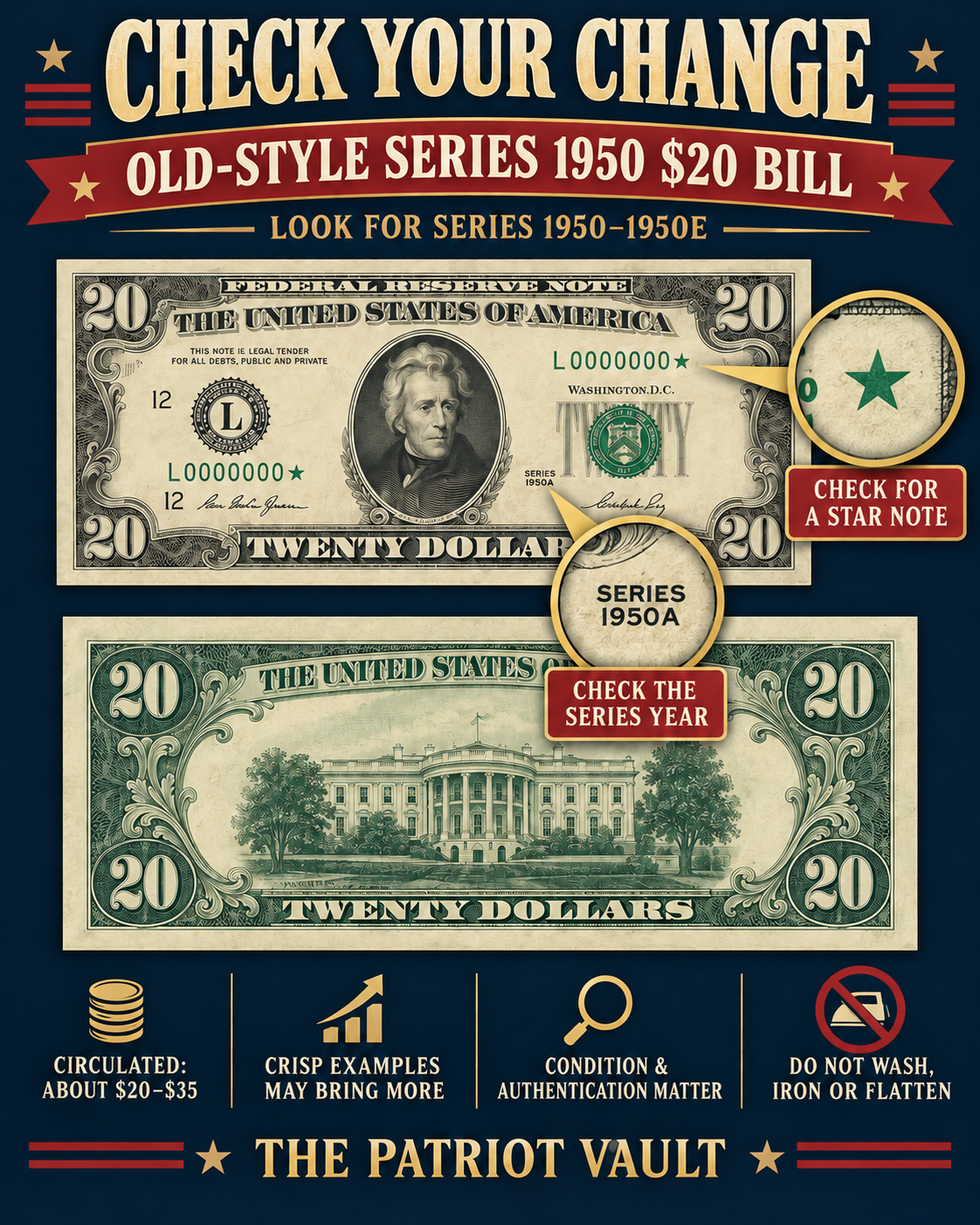

Modern twenties are colorful and packed with security features, but an older green-and-black $20 bill can carry a modest collector premium.
Today’s Check Your Change find is the Series 1950 $20 Federal Reserve Note. These notes can occasionally surface in cash drawers, older wallets, bank deposits and inherited currency collections.
What should you look for?
Start with the series designation printed on the front near the lower-right portion of Andrew Jackson’s portrait. It should read:
- Series 1950
- Series 1950A
- Series 1950B
- Series 1950C
- Series 1950D
- Series 1950E
The note has the familiar portrait of Andrew Jackson on the front and the White House on the back, but its appearance is noticeably different from a modern $20 bill.
Look for these features:
- A comparatively small portrait of Jackson
- Predominantly black-and-green printing
- A green Treasury seal
- An ornate border surrounding the portrait
- No background colors, portrait watermark or modern security thread
The absence of modern security features does not automatically authenticate an old bill. Paper texture, printing quality, serial numbers and other details should still be examined.
A little history
Andrew Jackson and the White House have appeared on the small-size $20 note since 1929. The Series 1950 design continued that familiar arrangement with several relatively minor design changes.
One change was the use of a smaller Treasury seal. The Bureau of Engraving and Printing notes that this smaller seal first appeared on Series 1950 Federal Reserve Notes. Later $20 redesigns introduced counterfeit deterrents such as security threads, watermarks, enlarged portraits and background colors.
The letter following 1950 does not represent the year the bill was printed. It generally identifies a later signature combination or production change within the same design series. Some Series 1950 notes continued being delivered well into the 1960s.
How much is a Series 1950 $20 bill worth?
Most Series 1950 twenties are collectible but not exceptionally rare.
As of October 2026, a heavily circulated ordinary example may trade close to its $20 face value, while an attractive Very Fine note commonly carries an approximate retail value of $25 to $35.
PMG’s price guide places common Series 1950 through 1950E notes at approximately $25 in Very Fine condition, around $30 to $50 in Extremely Fine condition, and roughly $60 to $100 in uncirculated grades, depending on the specific series.
A star replacing the final letter in the serial number identifies a replacement note and may add value. Certain Federal Reserve districts, uncommon serial-number combinations, printing errors and exceptionally well-preserved notes can also carry larger premiums.
Condition matters considerably. Folds, stains, writing, tears, missing pieces, tape and washed or pressed paper can reduce collector value. Online asking prices are not necessarily completed-sale values, and authentication determines what an individual note is actually worth.
What should you do if you find one?
Do not wash, iron, press, flatten, laminate or tape the note. Those actions can damage its original paper and reduce its value.
Photograph both sides, record the complete serial number and series designation, and place the bill flat in an archival-quality, PVC-free currency sleeve.
Have you found an old-style $20 bill—or do you have coins, paper currency or a broader collection? The Patriot Vault may be interested in buying your coin, currency or collection. Reply to this post and tell us what you have!