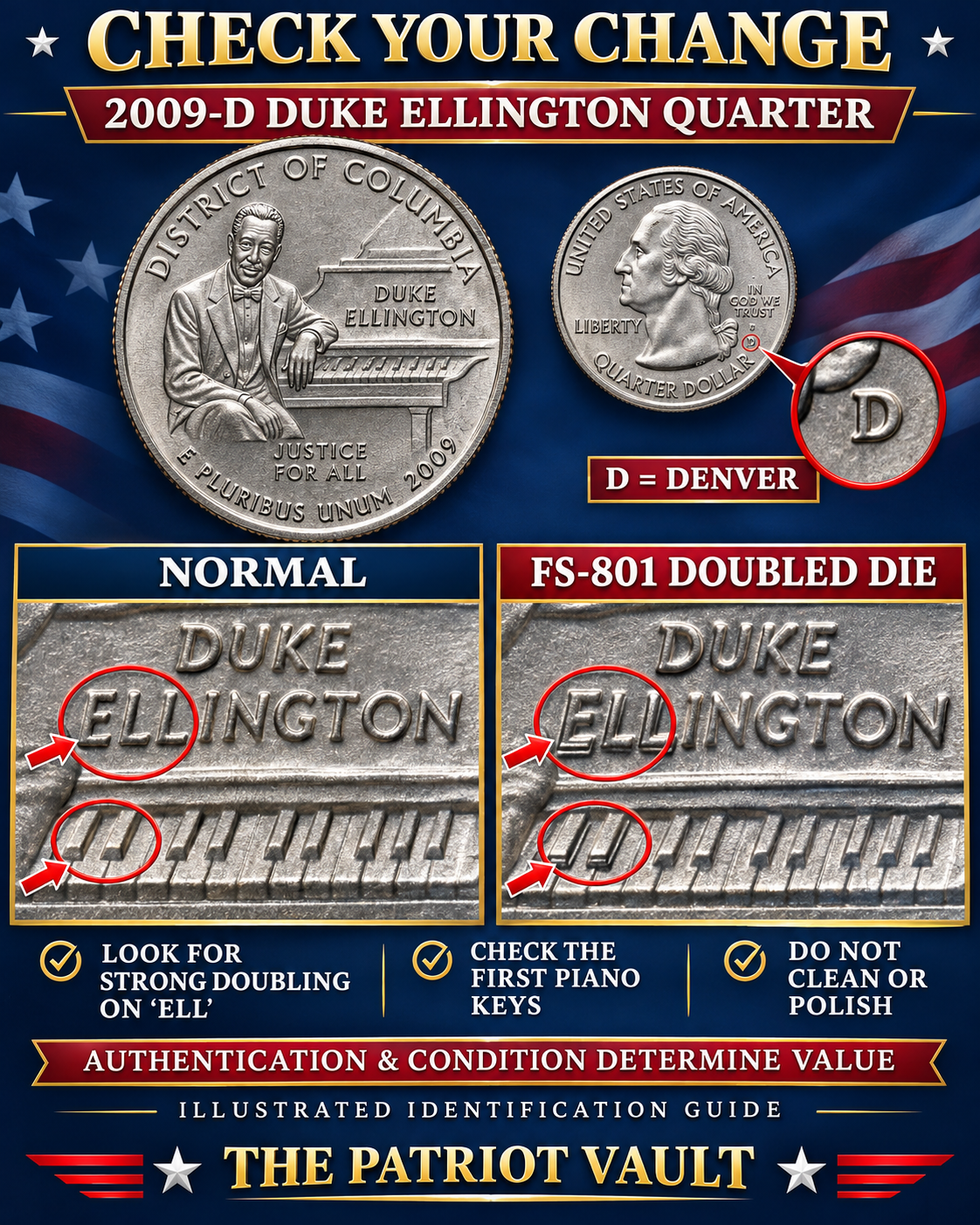
A District of Columbia quarter featuring legendary musician Duke Ellington may be worth considerably more than 25 cents if its reverse displays one dramatic form of doubling.
Today’s Check Your Change find is the 2009-D District of Columbia Doubled Die Reverse, cataloged as FS-801.
What should you look for?
Begin with a 2009 District of Columbia quarter. The reverse shows Duke Ellington seated at a piano.
Next, check the front near Washington’s neck ribbon. It must have a small D mintmark, identifying the Denver Mint. Philadelphia quarters with a P may display other minor varieties, but they are not the valuable Denver FS-801 discussed here.
Using magnification, examine the center of the reverse:
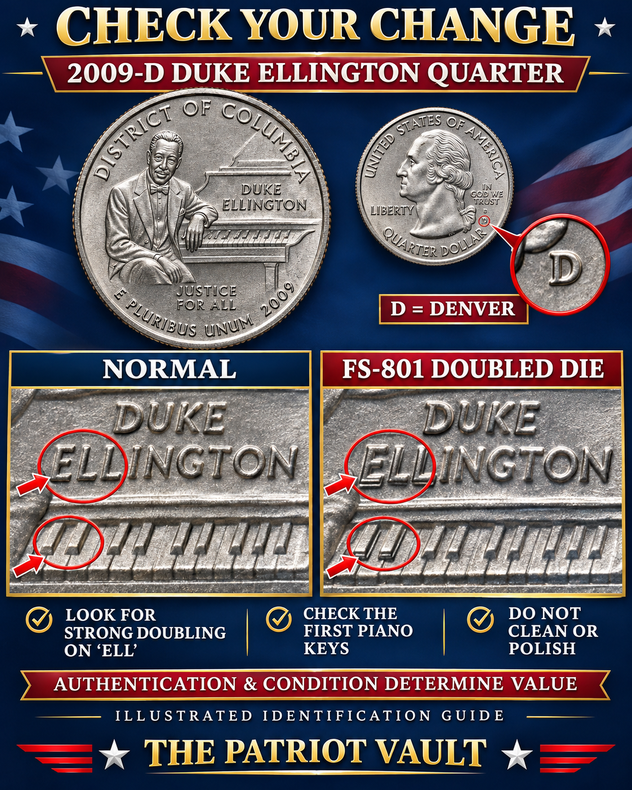
- Look closely at ELL in ELLINGTON
- Examine the first piano keys
- Check the panel immediately beneath the keyboard
- Inspect Ellington’s hand and upper arm
On the genuine FS-801 variety, the secondary design is widely separated and shifted diagonally down and to the right. The extra portions of ELL can be especially noticeable. PCGS describes it as the most significant doubled die found among the 2009 District of Columbia and U.S. Territories quarters.
Do not mistake flat, shelf-like machine doubling, scratches or damaged lettering for a true doubled die. The genuine variety has raised, rounded secondary details that match the established FS-801 pattern.
Why does this quarter feature Duke Ellington?
The District of Columbia quarter entered circulation on January 26, 2009. Its reverse, designed by Joel Iskowitz and sculpted by Don Everhart, depicts Washington-born composer and bandleader Duke Ellington seated at a piano. It also carries the district’s motto, JUSTICE FOR ALL.
The design was selected after more than 300 proposals were narrowed to three finalists and presented for a public vote. The Denver Mint produced 88.8 million regular District of Columbia quarters, but only a very small number are known with the dramatic FS-801 doubling.
How much is a 2009-D FS-801 quarter worth?
This variety is scarce enough that pricing can be uneven, especially for circulated examples.
Published collector guidance places recognizable circulated pieces at roughly $250 and higher, depending heavily on wear and certainty of attribution. Certified uncirculated examples have produced much stronger results:
- PCGS MS65: $1,126.12 in a GreatCollections sale
- PCGS MS66: approximately $3,055 in a 2014 Heritage auction
- NGC MS67: $3,099 in August 2023
These results are comparisons—not guaranteed values. A worn, damaged or questionable raw coin may bring substantially less. Authentication, grade, original surfaces and the strength of the doubling determine the actual market value.
What should you do if you find one?
Do not clean, polish, rub, scrape or otherwise alter the quarter. Never trace or sharpen the doubled lettering with a tool.
Hold it by the edges and photograph both sides. Take sharp close-ups of ELLINGTON, the piano keys and the panel below them. Place the coin in a non-PVC flip or protective capsule and consider professional variety attribution before offering it for sale.
Have you found a possible Duke Ellington doubled die—or do you have coins, paper currency or a broader collection? The Patriot Vault may be interested in buying your coin, currency or collection. Reply to this post and tell us what you have!