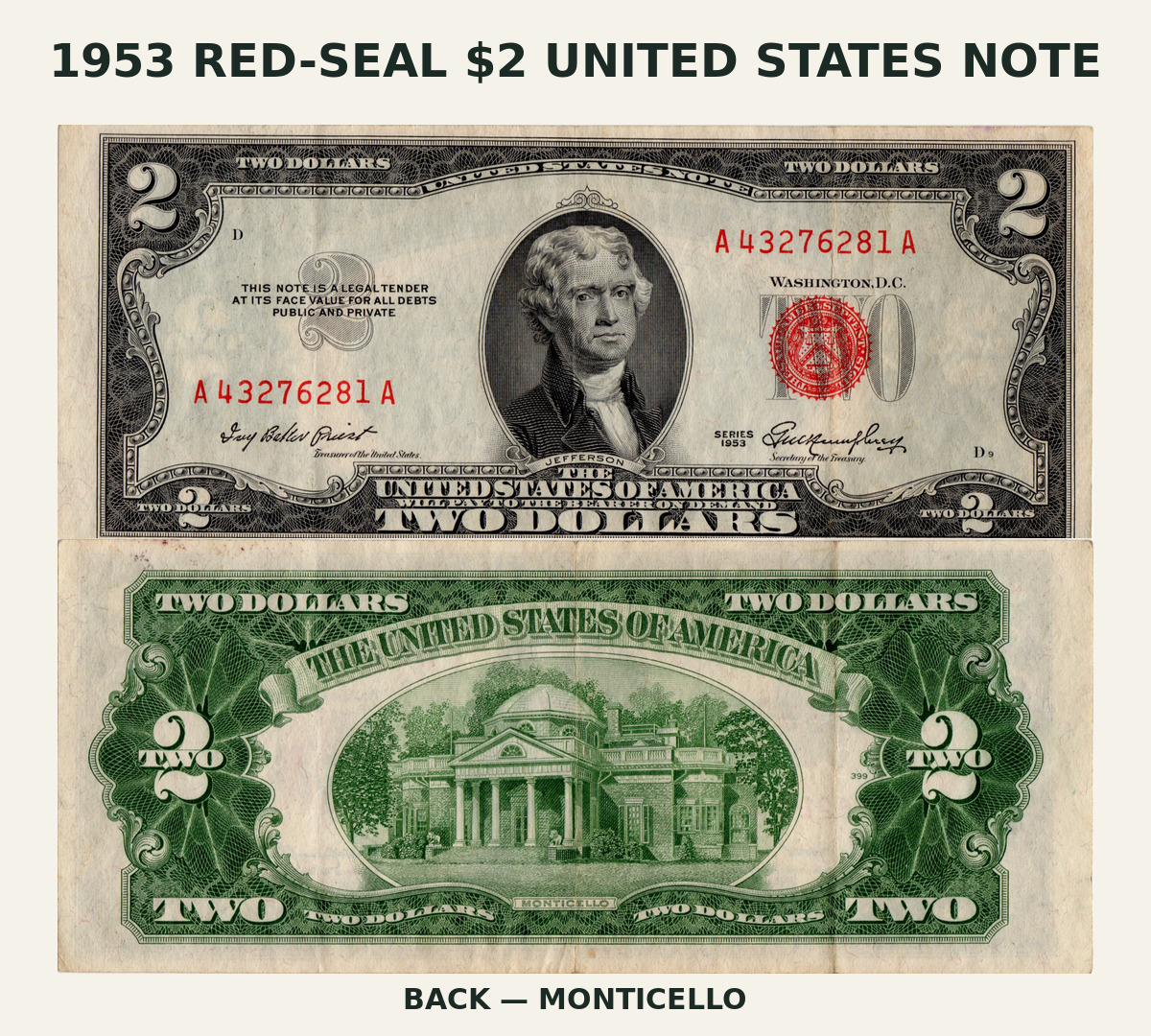
Most modern $2 bills have green Treasury seals, but an older note with a bright red seal is a collectible worth setting aside.
Today’s Check Your Change find is the Series 1953 or 1963 $2 United States Note, commonly called a “red-seal two.”
What should you look for?
Examine the front of the bill for these identifying features:
- A portrait of Thomas Jefferson
- A red Treasury seal to the right of Jefferson
- Two red serial numbers
- The words UNITED STATES NOTE across the top
- A series designation of 1953, 1953A, 1953B, 1953C, 1963 or 1963A
Some notes have a red star beside the serial number. These replacement notes were printed to take the place of sheets damaged during production and may carry an additional premium.
Turn the bill over and look for Monticello, Jefferson’s Virginia home. This makes the old red-seal note easy to distinguish from modern green-seal $2 Federal Reserve notes, which feature the signing of the Declaration of Independence on the back.
Why does it have a red seal?
These bills are United States Notes, also known as Legal Tender Notes—not Federal Reserve Notes.
Congress authorized United States Notes during the Civil War, and the red Treasury seal eventually became their most recognizable identifier. The government continued issuing this type of currency until 1971. All genuine United States currency remains legal tender at its printed denomination, although collector demand can make an older note worth more than face value. uscurrency.gov
The Series 1963A was the final red-seal $2 United States Note. When regular $2 production resumed for the nation’s Bicentennial in 1976, the denomination returned as a green-seal Federal Reserve Note with the Declaration of Independence design.
How much is a red-seal $2 bill worth?
Most Series 1953 and 1963 red-seal notes are collectible but not exceptionally rare.
As of September 2026:
- A heavily circulated ordinary note may sell for approximately $2.50 to $4
- A cleaner circulated example may bring roughly $4 to $8
- A crisp, uncirculated ordinary note may bring approximately $10 to $25
- Star notes, unusual serial numbers, printing errors and exceptionally high-grade examples may be worth more
Greensheet describes small-size red-seal Legal Tender Notes as generally common in circulated condition, and specialist market references place ordinary circulated examples only modestly above face value. Greensheet
Condition matters tremendously. Tears, stains, writing, missing corners, tape, pinholes and heavy folds reduce value. Online asking prices are not necessarily completed-sale prices, and authentication is required before treating an apparent printing error or unusual seal color as valuable.
What should you do if you find one?
Do not wash, iron, press, laminate or tape the bill. Do not attempt to brighten the red ink or flatten its folds; altering the paper can reduce collector value.
Handle it gently with clean, dry hands. Photograph the front and back, record the complete serial number and check for a star. Store the note flat inside an archival-quality, PVC-free currency sleeve.
Have you found a red-seal $2 bill—or do you have old coins, paper currency or an inherited collection? The Patriot Vault may be interested in buying your coin, currency or broader collection. Reply to this post and tell us what you have!