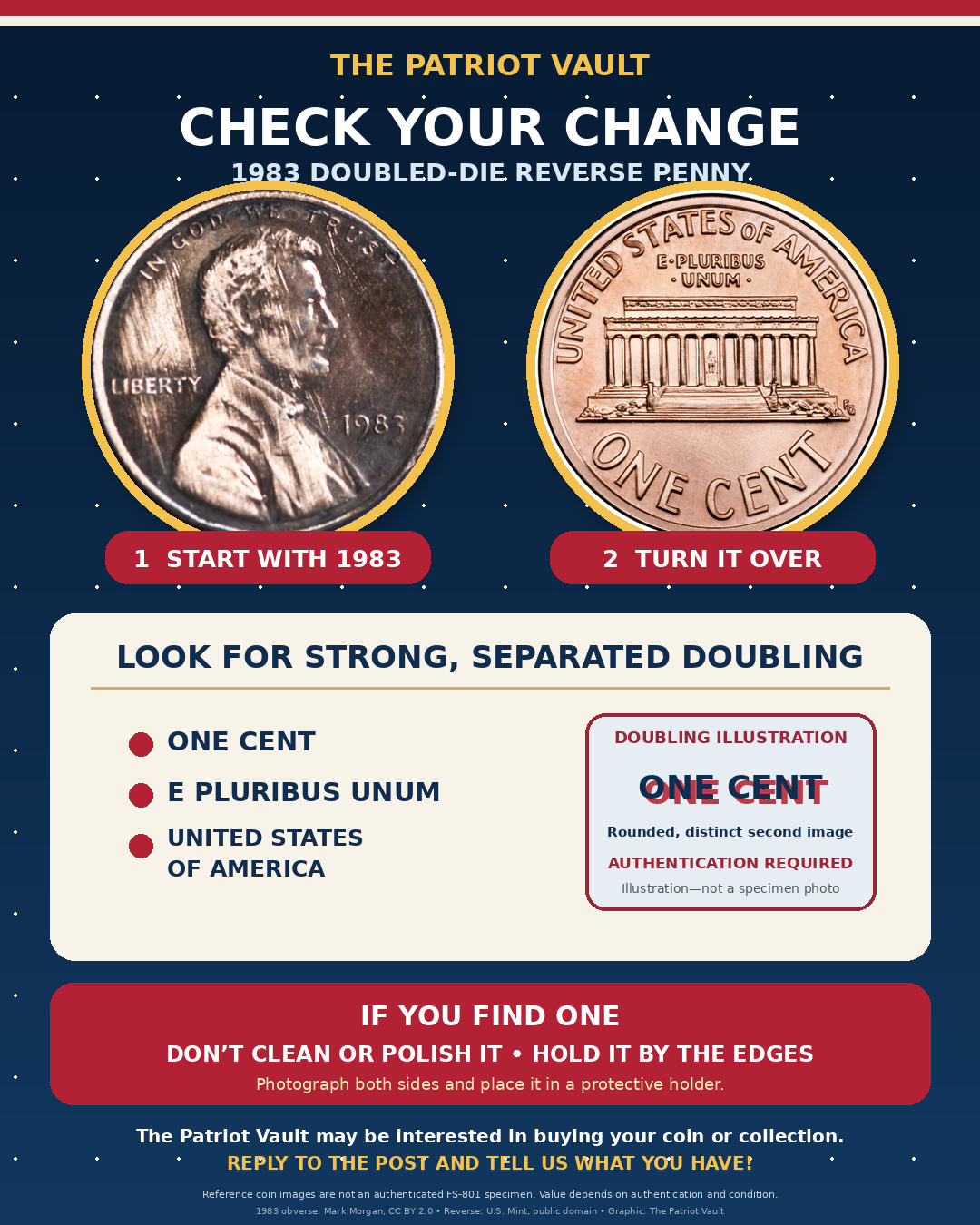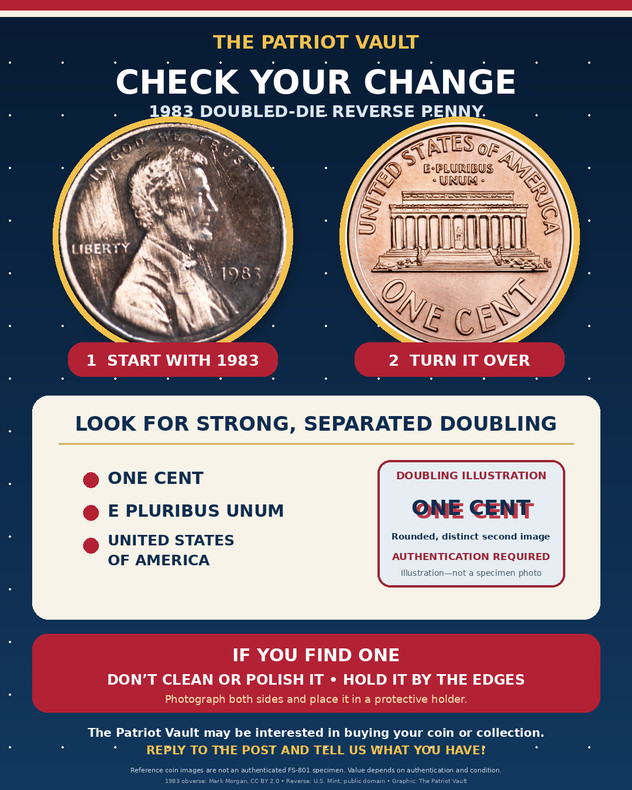
Most 1983 pennies are worth one cent, but one major variety displays dramatic doubling across the lettering on the back—and authenticated examples can be worth considerably more.
Today’s Check Your Change find is the 1983 Doubled Die Reverse Lincoln cent, commonly identified as FS-801.
What should you look for?
Begin with a Lincoln Memorial penny dated 1983 with no mintmark beneath the date. A 1983-D penny is not the major FS-801 variety discussed here.
Turn the penny over and examine the lettering surrounding the Lincoln Memorial. Look closely at:
- ONE CENT
- E PLURIBUS UNUM
- UNITED in “UNITED STATES OF AMERICA”
The genuine variety displays strong, separated doubling across the letters. PCGS describes it as possibly the strongest doubled-die reverse in the Lincoln cent series and notes that the effect can be visible without powerful magnification.
A magnifying glass or sharply focused phone photograph will make the separation easier to see. The front is generally normal; the important diagnostics are on the back.
How did the doubling happen?
A doubled die is created during the die-manufacturing process. If the hub that transfers the coin’s design to a working die is misaligned between impressions, portions of the design can appear twice on that die.
Every coin struck by the affected die then carries the same doubled features. This differs from a coin being struck twice or damaged after leaving the Mint.
Do not confuse the variety with machine doubling, which generally appears flat, shelf-like or smeared. Authentic doubled-die lettering normally retains rounded details with distinct separation. Compare any possible discovery with an authenticated FS-801 example before assuming it is genuine.
The 1983 cent was produced during an important transition. In 1982, the Mint changed the cent from a mostly copper composition to a lighter copper-plated zinc composition. A normal 1983 cent weighs approximately 2.5 grams.
How much is a 1983 doubled-die penny worth?
Value depends heavily on wear, original color, surface quality and professional authentication.
A genuine circulated or lightly worn example may be worth approximately $75 to $200, although damaged, corroded or cleaned coins may bring less.
Mint-state examples frequently sell for several hundred dollars. Recent 2026 certified auction results documented by Greysheet ranged from approximately $207 to $915, depending on grade and original red or red-brown color. Exceptional top-grade coins can bring more, but those results are not representative of a penny pulled from everyday change.
A normal 1983 penny without the recognized doubling is generally worth face value. Authentication and condition determine the actual market value.
What should you do if you find one?
Do not clean, polish, rub or scrape the penny. Never try to enhance the doubling. Cleaning and alteration can permanently damage the surface and reduce its value.
Hold the coin by its edges, photograph both sides and take sharp close-ups of ONE CENT, E PLURIBUS UNUM and UNITED. Place it in a non-PVC coin flip or protective capsule and seek professional attribution before selling it.
Have you found a possible 1983 doubled-die penny—or do you have coins, paper currency or a larger collection? The Patriot Vault may be interested in buying your coin, currency or broader collection. Reply to this post and tell us what you have!