Why Is Vietnamese Dong Made of Polymer Instead of Paper?
If you've ever held a modern Vietnamese Dong banknote, one of the first things you may notice is that it feels very different from a traditional U.S. dollar bill.
There's a good reason for that.
Many of Vietnam's current banknotes aren't actually made from traditional paper at all. They're printed on polymer, a thin and highly durable plastic-based material specifically designed for currency.
But when did Vietnam make the switch to polymer currency — and why?
Vietnam Introduces Polymer Banknotes
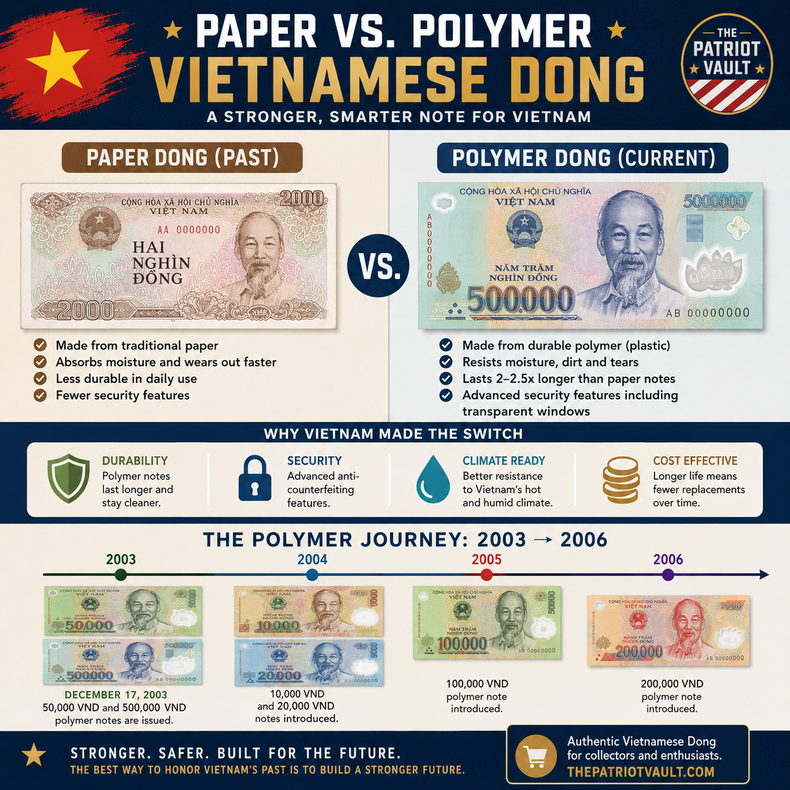
Vietnam began introducing its modern series of polymer Vietnamese Dong banknotes in 2003.
Two of the most recognizable denominations, the 50,000 Vietnamese Dong note and 500,000 Vietnamese Dong note, were issued on December 17, 2003.
The transition continued over the following years as additional polymer denominations were introduced, eventually creating the familiar group of polymer notes collectors recognize today:
- 10,000 VND
- 20,000 VND
- 50,000 VND
- 100,000 VND
- 200,000 VND
- 500,000 VND
By 2006, Vietnam had completed the introduction of this six-denomination polymer series.
Why Did Vietnam Switch From Paper to Polymer?
There wasn't just one reason. Polymer offered several important advantages for a country with a large cash-based economy and a hot, humid climate.
1. Polymer Banknotes Are More Durable
Traditional banknotes gradually become dirty, worn, torn and damaged as they change hands.
Polymer is much more resistant to moisture and everyday wear. That allows banknotes to remain usable and presentable for longer periods before they need to be removed from circulation and replaced.
For a country circulating enormous quantities of cash, extending the useful life of a banknote can be an important advantage.
2. Improved Protection Against Counterfeiting
One of the most interesting features of polymer currency is the ability to incorporate security elements that are difficult for counterfeiters to reproduce.
Take a close look at a current Vietnamese Dong polymer note and you'll notice one of its most obvious security features: transparent windows built directly into the banknote.
Vietnamese polymer notes also incorporate multiple security and printing features that can be checked by looking through the note, touching raised printing, tilting the banknote and examining other elements.
It's one of the reasons these notes are so interesting to currency collectors.
3. Resistance to Vietnam's Climate
Vietnam has a tropical climate, with high temperatures and significant humidity throughout much of the country.
Paper-based currency can absorb moisture and deteriorate through repeated handling.
Polymer's resistance to moisture and dirt makes it particularly well suited for currency that must survive constant everyday use in those conditions.
4. Longer Circulation Life
Durability ultimately means a banknote can potentially stay in circulation longer.
Although producing sophisticated polymer currency can be more complex than producing conventional notes, longer-lasting banknotes can reduce how frequently worn currency needs to be withdrawn and replaced.
Is Vietnamese Dong Actually Plastic Money?
Essentially, yes.
Although people commonly refer to banknotes as "paper money," the substrate used for modern Vietnamese polymer notes is a thin polymer film rather than conventional paper fibers.
Special coatings are applied to portions of the polymer substrate so that detailed designs, colors, portraits, numbers and security features can be printed onto it.
Certain areas can remain transparent, creating the distinctive clear security windows found on modern Vietnamese currency.
It's an interesting combination of currency design, materials science and anti-counterfeiting technology.
What Is Printed on Modern Vietnamese Dong?
The modern Vietnamese Dong series is also interesting because of its artwork.
The front of the polymer banknotes prominently features Ho Chi Minh, while the reverse sides depict important Vietnamese cultural, historical and geographic locations.
For example, the reverse of the 500,000 VND banknote depicts the village of Sen in the Kim Lien area of Nam Dan, Nghe An Province, associated with Ho Chi Minh's birthplace.
The 200,000 VND note depicts Dinh Huong Islet in Ha Long Bay, while the 100,000 VND note features Khue Van Cac at Hanoi's historic Temple of Literature.
These designs give collectors more than just different denominations to study — each banknote provides a small window into Vietnamese history and culture.
Vietnamese Dong for Currency Collectors
Whether you're interested in world history, unusual banknote materials, security features or simply enjoy building a collection of foreign currency, the modern Vietnamese Dong is a fascinating series.
The transition from traditional banknote materials to polymer beginning in 2003 represents an important chapter in the evolution of Vietnam's currency.
At The Patriot Vault, we offer genuine Vietnamese Dong and collectible banknotes from countries around the world. We source our currency from reputable suppliers, and every note we sell is guaranteed authentic.
?? Collect the world — from right here in America.
Visit thepatriotvault.com to see our current selection of Vietnamese Dong and other collectible world currency.